


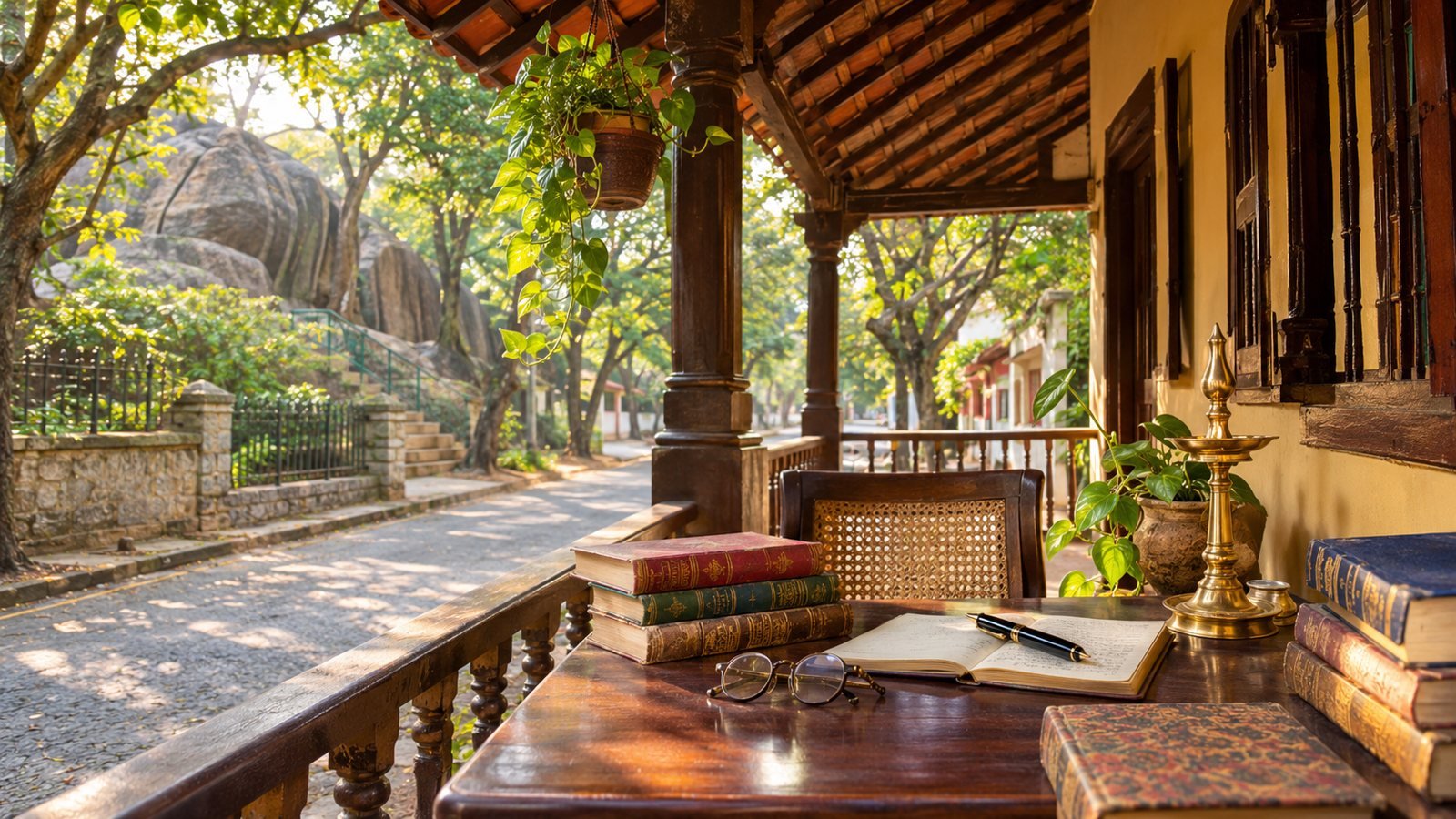
“Every Bengaluru family has a grandparent who answers a crisis with a four-line verse from the Kagga. That grandparent learned it from DVG.”
• Tariq Sallam, on the most quoted man in Basavanagudi
If you have ever walked down DVG Road in Basavanagudi looking for a dosa, a saree or a parking spot, you have walked down a road named after one of the most remarkable people this city has ever produced. Devanahalli Venkataramanaiah Gundappa, known to every Kannadiga simply as DVG, was a journalist, poet, philosopher, institution builder and public intellectual who did most of his life's work right here in old Bangalore.
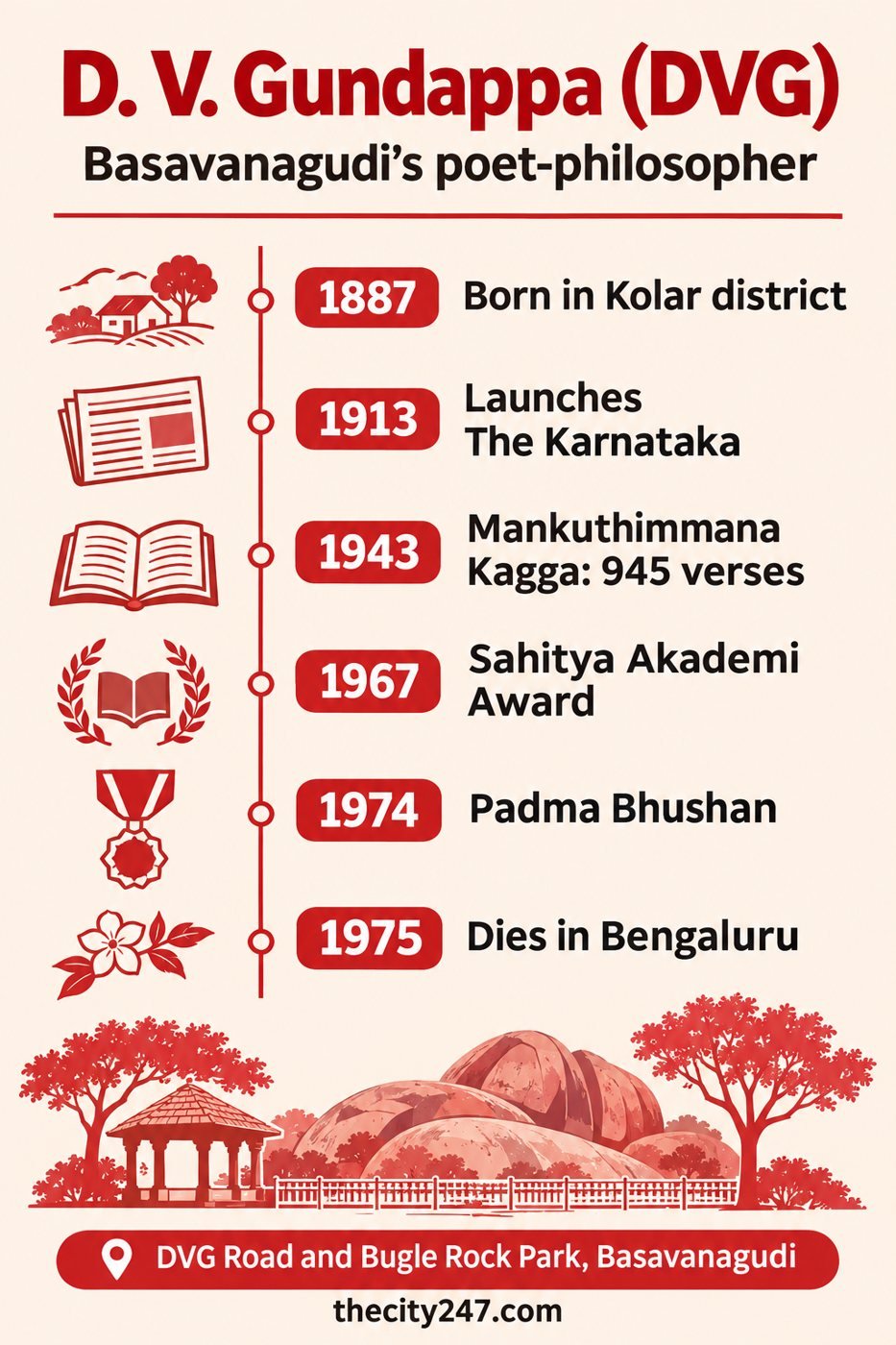
He is best known for Mankuthimmana Kagga, a collection of 945 four-line verses published in 1943, which many readers call the Bhagavad Gita of Kannada. But I find the man behind the book just as interesting: a matriculation dropout who taught himself Sanskrit and English, worked odd jobs including at the Kolar gold fields and a soda factory, then moved to Bangalore with almost nothing and became one of its sharpest editors and thinkers.
This is my People of Bangalore profile of DVG: who he was, what he built in this city, why the Kagga still sells, where you can still find his footprints in Basavanagudi, and what a Bengalurean in 2026 can take from a man who lived simply, argued fearlessly and gave away his prize money.
Quick Information
Failed his matriculation, then wrote the book your grandmother quotes at weddings and funerals. Exams, as it turns out, are not everything.
Who Was D. V. Gundappa?
DVG was a Kannada writer, journalist and philosopher, regarded as one of the giants of twentieth-century Kannada literature and one of the most influential public voices of the old Mysore State.
He wrote more than 35 books across poetry, philosophy, biography, political science and memoir, and edited newspapers for decades. Admirers call him the Ashvatthavruksha of Kannada literature, the great peepul tree, because so much of what came after grew in his shade. Others simply called him a rishi, a sage who happened to own a printing press.
What makes him a true Bengalurean in my book is that so much of this happened in one neighbourhood. He lived, wrote, argued and taught in Basavanagudi for much of his adult life, and the area still carries his name on its streets and in its institutions.
How Did DVG Go From a Kolar Village to Bangalore?
The hard way. He grew up in Kolar district, studied in Kannada medium, moved to Maharaja High School in Mysore, failed his matriculation exam and left formal education behind.
What followed reads like a modern startup founder's origin story, minus the venture capital. He worked as a substitute teacher in Mulbagal, then at the Kolar gold mines, then at a soda factory. Along the way he taught himself Sanskrit and English with the kind of discipline most of us cannot manage for a Duolingo streak.
He came to Bangalore looking for work and started writing for English newspapers to support his family. That first foothold in journalism turned into a lifelong career, and the city turned into his home.
“No degree, no connections, no money. Just a pen, a library card and a refusal to write anything he did not mean.”
• Tariq Sallam, on DVG's early Bangalore years
What Did DVG Do as a Journalist in Bangalore?
He founded and edited publications that became platforms for serious public debate in the Mysore State, in both Kannada and English, starting from around 1906 to 1907.
- Bharata and Karnataka: Kannada newspapers he started early in his career.
- The Karnataka: An English publication launched on 2 April 1913 with the encouragement of Diwan Sir M. Visvesvaraya. It later carried Kannada writing too, and ran until 1921.
- Sumathi: A weekly, along with the Sumathi Granthamale publishing imprint.
- Vrutta Patrike (1928): His book on how newspapers work, one of the early Kannada texts on journalism itself.
His journalism was famously independent. He was willing to criticise the administration of the day when he felt it was wrong, a habit that does not always make editors popular, then or now. For a city that today argues about potholes on Twitter, it is worth remembering that Bangalore had a public conscience long before it had a hashtag.
What Is Mankuthimmana Kagga and Why Is It So Famous?
Mankuthimmana Kagga is a book of 945 four-line verses on life, fate, effort, grief and acceptance, published in 1943 and written in the voice of a humble, slightly foolish narrator called Mankuthimma.
The title roughly means the rigmarole of dull Thimma, which is DVG's very Bengaluru way of disguising profound philosophy as the ramblings of a nobody. The verses draw on Vedanta and Indian philosophy but read as practical, almost conversational advice about how to live in a confusing world without losing your balance.
Its staying power is extraordinary. More than eight decades later it is recited in schools, quoted in speeches, set to music, explained in long lecture series and translated into Tamil, Telugu and English. A sequel collection, Marula Muniyana Kagga, with 825 more verses, was published after his death.
If you do not read Kannada, start with an English translation of the Kagga and a lecture series that explains it verse by verse. Reading four lines a day with your morning coffee is a very DVG way to begin.
What Else Did DVG Write?
A great deal, across an unusually wide range. Beyond the Kagga, these are the works most often recommended.
- Srimad Bhagavadgeeta Tatparya (Jeevana Dharma Yoga): His commentary on applying the Gita to everyday life, which won the Sahitya Akademi Award in 1967.
- Jnapaka Chitrashaale: An eight-volume series of reminiscences and portraits of people he knew, written in his later years. A goldmine for anyone curious about old Bangalore and Mysore society.
- Vasantha Kusumanjali (1922) and Nivedana (1942): His poetry collections.
- Rajya Shastra (1952): A Kannada book on political science, alongside English works on constitutional principles and probity in public life.
- Biographies: Of Diwan Rangacharlu, Gopalakrishna Gokhale and Dadabhai Naoroji.
What Is the Gokhale Institute of Public Affairs?
It is the institution DVG founded in Basavanagudi in the 1940s to encourage informed public life, inspired by the statesman Gopal Krishna Gokhale's idea of public service as a kind of spiritual practice.
The Gokhale Institute of Public Affairs, on Bull Temple Road, still runs talks on public affairs, philosophy and literature, and keeps a reference library. Some of Karnataka's best-known scholars and speakers have lectured there over the decades. Sources differ slightly on the exact founding year, so if you want it for a quiz, check with the institute itself.
DVG put his money where his convictions were. When the Karnataka government honoured him in 1970 with a purse, he is reported to have handed the money to the institute. For a man who lived frugally all his life, that gesture says more than any citation.
What Was DVG's Role in Bangalore's Public Life?
He was a civic participant as well as a commentator. In 1912 he was nominated to the Bangalore Municipal Council during Sir M. Visvesvaraya's time as Diwan, and he served on the Senate of the University of Mysore.
He also presided over the 18th Kannada Sahitya Sammelana at Madikeri in 1932, a mark of how central he was to the Kannada literary world. Through his writing on constitutions and public ethics, he kept pressing one idea: that good government depends on citizens who are informed, honest and willing to show up.
“A citizen who reads, questions and shows up is worth ten who complain. DVG was the first kind, for about seventy years.”
• Tariq Sallam
Where Can You Find DVG's Legacy in Bengaluru Today?
Mostly in Basavanagudi, which is exactly where you should spend a slow morning paying your respects.
- DVG Road, Basavanagudi: The road where his Nagasandra Road home once stood was renamed in his honour. Today it is one of South Bengaluru's busiest shopping streets.
- His statue in Bugle Rock Park: Unveiled in 2003, a short walk from the Bull Temple and Dodda Ganesha.
- The Gokhale Institute of Public Affairs: On Bull Temple Road, still hosting talks. Check their notices for public lectures.
- Bookshops and lecture halls: Kagga translations, commentaries and recorded lectures are widely available, and talks on the Kagga are held regularly across the city.
- A 1988 postage stamp: India Post honoured him with a commemorative stamp, a nice find for collectors.
My suggested DVG morning: breakfast on the old South Bengaluru food trail, a walk to Bugle Rock Park to see the statue, the Bull Temple next door, and a browse along DVG Road. You will see a neighbourhood that still feels like the city he knew, at least before the traffic wakes up.
Why Does DVG Belong in People of Bangalore?
DVG built his life in Bengaluru. He arrived looking for work, edited newspapers here, founded the Gokhale Institute in Basavanagudi, served on the Bangalore Municipal Council, and died in the city in 1975. A road and a statue in Basavanagudi carry his name.
He also represents something this city needs more of in 2026: a self-made intellectual who cared about public life, wrote clearly, lived simply and gave back. If Bengaluru has a conscience, a good chunk of it was written in Basavanagudi.
I haven't interviewed DVG for this piece, for fairly obvious reasons. It is pieced together from online research: encyclopaedia entries, published articles, commemorative records and books, cross-checked where possible. If you spot an error, or your family has a DVG story, please tell me.
D. V. Gundappa: Frequently Asked Questions
Who was D. V. Gundappa?
D. V. Gundappa (DVG) was a Kannada poet, journalist and philosopher, born in 1887 in Kolar district, who lived and worked in Bengaluru. He is best known for Mankuthimmana Kagga and for founding the Gokhale Institute of Public Affairs.
What is DVG's full name?
Devanahalli Venkataramanaiah Gundappa. DVG is the short form used almost universally.
What is Mankuthimmana Kagga?
A collection of 945 four-line philosophical verses by DVG, published in 1943. It is often called the Bhagavad Gita of Kannada and is still widely quoted and taught.
How many verses are in Mankuthimmana Kagga?
945. A sequel, Marula Muniyana Kagga, has 825 verses and was published after his death.
Which awards did D. V. Gundappa receive?
Among others, an honorary doctorate from the University of Mysore (1961), the Sahitya Akademi Award (1967) for Srimad Bhagavadgeeta Tatparya, and the Padma Bhushan (1974). India Post issued a stamp in his honour in 1988.
Where is DVG Road in Bangalore?
In Basavanagudi, South Bengaluru. It was named after DVG, whose home stood on what was then Nagasandra Road.
Where is the DVG statue in Bengaluru?
In Bugle Rock Park, Basavanagudi, near the Bull Temple. It was unveiled in 2003.
What is the Gokhale Institute of Public Affairs?
An institution founded by DVG in Basavanagudi, on Bull Temple Road, to promote informed public life. It hosts talks on public affairs, philosophy and literature and has a reference library.
When did D. V. Gundappa die?
On 7 October 1975, in Bengaluru, at the age of 88.
Grew Up on the Kagga?
If your grandparents knew DVG, attended his talks at the Gokhale Institute, or have a favourite verse they quote at every family crisis, I would love to hear it. Click the WhatsApp icon at the bottom right of your screen and tell me. That is also the easiest way to reach The City 24/7 about anything at all.
Want a new People of Bangalore story every week? Join the newsletter at thecity247.com/newsletter.
Same city, new stories, always.

Related Stories
 MUSIC
V Harikrishna: The Bengaluru Composer Who Won Three Filmfares in a Row
October 26, 2026
 SCIENCE
Sir C V Raman: The Nobel Laureate Who Chose Bengaluru and Stayed
October 21, 2026
 FOUNDERS
V G Siddhartha: How Brigade Road Got India's First Cafe Coffee Day
October 17, 2026
 SCIENCE
Raja Ramanna: The Physicist Who Played the Piano and Founded NIAS
October 3, 2026
 THEATRE
B V Karanth: The Man Who Put Music Into Kannada Theatre
October 2, 2026
 SPIRITUALITY
Sri Sri Ravi Shankar: The Art of Living and the Ashram on Kanakapura Road
October 2, 2026
