


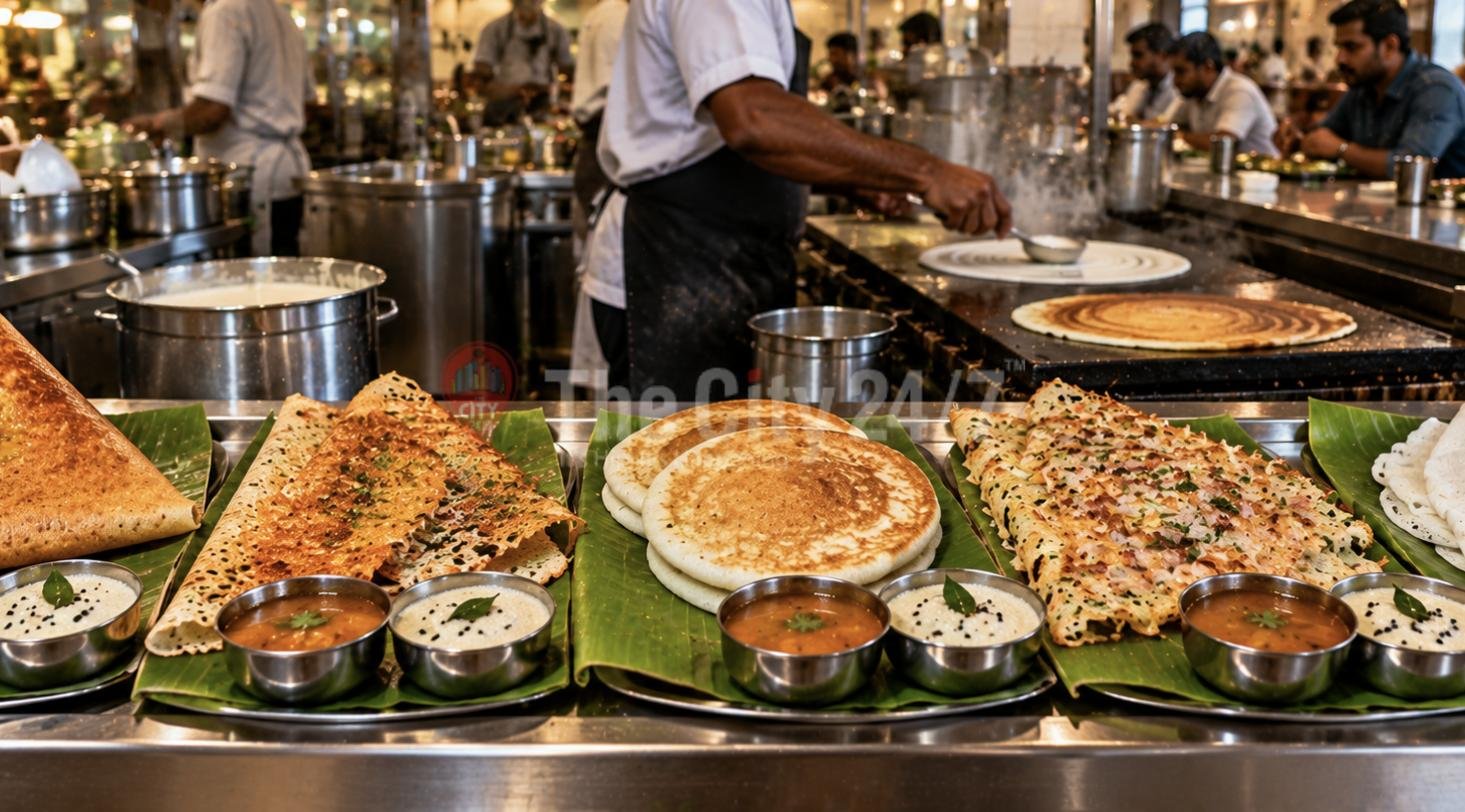
“The remarkable thing about dosas in Bengaluru is not the best one. It is that the average one, at a random counter in a residential street, is better than a carefully researched dosa almost anywhere else.”
• On a city with an extremely high floor
I am not going to give you a ranked list of ten restaurants, because that is how dosa guides fail. The great dosa places in this city number in the hundreds, they are spread across every residential neighbourhood, and the one three minutes from where you are standing is probably excellent. What is genuinely useful is knowing the types, knowing how to judge one, and knowing which areas reward a journey.
The dosa is a fermented rice and lentil batter cooked on a flat griddle, and everything interesting about it happens in those two facts: how the batter was fermented, and what the griddle has absorbed over the years. A thirty year old cast iron tawa seasoned continuously is not replaceable equipment, and it is most of why old darshinis beat new ones.
So this covers the six dosas worth knowing, the four quality signals, where to go, what to pay, and how to order without getting the tourist version. Our local food and breakfast guides cover the wider repertoire.
Quick Information
Six dosas and what each one is. Prices are for darshinis and counters, where the good ones are.
What Is the Difference Between the Types of Dosa?
Crispness, fat and thickness. A masala dosa is crisp with potato inside, a benne dosa is soft and cooked in butter, a set dosa is thick and spongy, and a paper roast is enormous and thin with nothing in it.
- Masala dosa. The benchmark. Crisp on the outside, soft inside, folded over spiced potato palya, served with coconut chutney and sambar. If you order one thing in Bengaluru, this is it.
- Benne dosa. The Davangere style, cooked with generous butter on the griddle. Smaller, softer, richer, and served with a coarse potato palya and chutney. Many people who try both prefer this one.
- Set dosa. Three soft, thick, spongy dosas served as a set, usually with sagu, a mixed vegetable curry, and chutney. Completely different texture, and the right order if you want something filling.
- Paper roast. A very large, very thin, very crisp dosa with no filling, often rolled into a cone and taller than the table. Partly spectacle, and genuinely good when the batter is right.
- Neer dosa. The coastal Mangalorean version: unfermented, thin, soft and lacy, eaten with coconut based fish or chicken curries. Not a breakfast dosa and not interchangeable with the others.
- Ragi dosa. Made with finger millet, darker, earthier and more nutritious. Underordered, and a good answer for anybody avoiding refined grains.
- Rava dosa and onion dosa. Rava dosa is semolina based, lacy and very crisp, usually with onion and chilli. Both are excellent and both are quicker than fermented batter, which is why they appear at odd hours.
How Do I Tell a Good Dosa Place From an Average One?
Look at the griddle, smell the batter, taste the chutney and count the customers. Those four signals will tell you more in thirty seconds than any review.
The griddle is the biggest single factor. A large, dark, heavily seasoned cast iron tawa that has been in continuous use for decades cooks differently from a new one, and you can see it from the door. Watch how the cook oils it, spreads the batter in one motion and lifts the dosa off cleanly. If the dosa sticks or tears, the griddle or the batter is wrong.
Fermentation is the second. A properly fermented batter has a faint sourness you can smell, and that sourness is the flavour foundation of the whole dish. A bland dosa is almost always an under fermented or over rushed batter. Third, taste the chutney: freshly ground coconut chutney with the right coarseness is the mark of a kitchen that cares, and a thin poured chutney from a container tells you what the rest will be like. And fourth, a full counter at eight in the morning means continuous cooking, which is the difference between a dosa made now and one made twenty minutes ago.
“The single best predictor of a good dosa is a griddle nobody has replaced in thirty years, standing in front of a queue.”
• Thirty seconds of observation beats any review
Where Should I Go for Dosas in Bangalore?
The older residential neighbourhoods: Basavanagudi, Malleshwaram, Jayanagar, VV Puram, Rajajinagar and Vijayanagar. These areas have the highest density of old, established counters and the most demanding regular customers.
Basavanagudi and Gandhi Bazaar are the classic destination and justify a specific journey: multiple decades old establishments within a few hundred metres, plus sweet shops, coffee and the flower market, and the Bull Temple and Bugle Rock alongside for a walk afterwards. Malleshwaram, particularly around 8th Cross, is the north Bengaluru equivalent and is on the Green Line.
Jayanagar 4th Block and the surrounding blocks are dense with excellent counters serving a demanding local clientele, and VV Puram adds street food in the evening. Rajajinagar and Vijayanagar in the west are less visited and equally good. What all of these share is an old residential population that has been eating dosas in the same places for forty years and will simply stop going if standards slip, which is the most effective quality control mechanism ever devised.
What Should I Order and How Much Should It Cost?
A masala dosa and a filter coffee, for roughly sixty to a hundred and sixty rupees together. That is the complete experience and anything more expensive is usually paying for chairs.
Prices at a good darshini: masala dosa forty to a hundred and twenty rupees, benne dosa fifty to a hundred and thirty, set dosa forty to a hundred, paper roast sixty to a hundred and fifty, and filter coffee fifteen to forty. A full breakfast for two, two dosas, an idli vada and two coffees, comes in under three hundred rupees at most counters.
Sit down restaurants charge two to four times this for the same dish, and occasionally it is worth it for comfort, air conditioning and a table when you have somebody with you who will not stand at a ledge. The food itself is rarely better. Ask for extra chutney, which is usually free and always worth having, and if benne dosa is on the menu at a place that specialises in it, order that instead of the masala.
What Mistakes Do People Make With Dosas Here?
- Letting it sit. A dosa has a five minute window. Photograph it quickly or not at all, because a crisp dosa becomes a soft one faster than you would think.
- Going at eleven thirty. Peak breakfast is seven to half past ten. Arrive at the end of service and you get what did not sell, from a cooling griddle.
- Eating it with a fork. Tear a piece with your right hand, scoop chutney, eat. A fork shatters it and loses you the good bits. Nobody will mind either way, but the hand works better.
- Judging by decor. The best dosa in a neighbourhood is frequently at the least impressive looking place on the street. Worn is fine. Empty is the warning sign.
- Ordering a cheese dosa first. Fine as a curiosity, and not what this city is good at. Have a masala or benne dosa before you experiment.
- Skipping the coffee. Filter coffee in a steel tumbler and dabarah is half the experience, it costs fifteen to forty rupees and it is meant to be drunk there rather than carried away.
- Only trying dosa at sit down restaurants. Comfortable, and you are paying a premium for a chair. The counters are where the cooking is best.
Dosas in Bangalore: Frequently Asked Questions
What is the best type of dosa in Bangalore?
Masala dosa is the benchmark, crisp with spiced potato inside. Benne dosa, the Davangere style cooked in generous butter, is softer and richer and many people prefer it once they try both. Set dosa is the right order for something thicker and more filling.
How much does a dosa cost in Bangalore?
Roughly Rs 40 to 120 for a masala dosa at a darshini, Rs 50 to 130 for benne dosa, Rs 40 to 100 for set dosa and Rs 60 to 150 for paper roast, with filter coffee at Rs 15 to 40. Sit down restaurants charge two to four times as much for the same dish.
How do I tell if a dosa place is good?
Look at the griddle, which should be large, dark and heavily seasoned from decades of use; smell the batter for a faint sourness indicating proper fermentation; taste the chutney, which should be freshly ground rather than poured; and check that the counter is busy, meaning continuous cooking.
Which area of Bangalore is best for dosas?
Basavanagudi and Gandhi Bazaar, followed by Malleshwaram around 8th Cross, Jayanagar 4th Block, VV Puram, Rajajinagar and Vijayanagar. These older residential areas have the highest density of long established counters and the most demanding regular customers.
What is benne dosa?
The Davangere style dosa, cooked with generous butter on the griddle, making it smaller, softer and richer than a crisp masala dosa. It is served with a coarse potato palya and chutney, and it is worth seeking out specifically at places that specialise in it.
What is the difference between set dosa and masala dosa?
A masala dosa is a single crisp dosa folded over spiced potato. A set dosa is a stack of three soft, thick, spongy dosas served with sagu, a mixed vegetable curry, and chutney. They are completely different in texture and both are worth ordering.
What time should I eat dosa in Bangalore?
Between seven and half past ten in the morning for peak breakfast service, or between four and half past six in the evening for tiffin. Both are times of high turnover, which means dosas are coming off the griddle continuously.
Should I eat dosa with my hands?
It works better. Tear a piece with your right hand, scoop up chutney and eat. A fork tends to shatter a crisp dosa. Nobody will mind if you use cutlery, but the hand is the more effective tool.
What is neer dosa?
A coastal Mangalorean dosa, unfermented, thin, soft and lacy, eaten with coconut based fish or chicken curries rather than chutney and sambar. It is not a breakfast dosa and is served at coastal restaurants rather than darshinis.
What should I drink with a dosa?
Filter coffee, served as decoction and hot milk in a steel tumbler and dabarah for Rs 15 to 40. It is meant to be drunk there rather than carried away, and the pouring between tumbler and dabarah is part of getting the temperature right.
Know a Counter I Should Be Eating At?
The best dosa in any Bengaluru neighbourhood is known to the streets around it and to nobody else, which is exactly why a ranked list would be useless. If your local counter deserves attention, click the WhatsApp icon at the bottom right of your screen and tell me where it is. These are my favourite messages to receive. That is also the fastest way to reach The City 24/7 about anything at all.
And if you want the city explained one useful thing at a time, join our ever growing community. One weekly email, free, and reliably hungry.
Same city, new stories, always.

Related Stories
 DINING
A Guide to Bangalore's Famous Local Food, and Where to Eat Each One Properly
September 11, 2026
 DINING
The Best Bakeries in Bangalore: Iyengar, Cantonment and the New Sourdough
September 11, 2026
 DINING
The Best Coffee in Bangalore: Filter Coffee, Specialty Roasters and Everything Between
September 11, 2026
 DINING
The Ultimate Bangalore Food Guide: What to Eat, Where, and When
September 9, 2026
 DINING
The Best Biryani in Bangalore: Five Styles, One City, Endless Arguments
September 8, 2026
 DINING
The Best Breakfast in Bangalore: A Complete Guide to the City's Finest Meal
September 8, 2026
