



“The best money a startup can raise is the money that does not ask for equity. In Karnataka, that money has a name: ELEVATE.”
• Tariq Sallam, on the cheapest cheque in Bengaluru
Every founder I meet in Bengaluru is raising money, has just raised money or is pretending not to raise money. Very few of them have applied for the one cheque that does not cost them a single share: the Karnataka government's ELEVATE grant. Some have never heard of it, some think it is only for IIT graduates with lab coats, and some started the application and gave up at the pitch deck. All three are making a mistake.
ELEVATE has been running since 2017, and across 24 calls in roughly a decade it has backed more than 1,250 startups with about Rs 292 crore in committed grants, including about Rs 77 crore for women-led startups and over Rs 102 crore for startups outside Bengaluru. In 2026 the state added ELEVATE NxT, a deeptech programme with grants of up to Rs 1 crore. This guide explains how it all works and how to give yourself a real chance.
One important caveat: eligibility rules, deadlines and tracks are set afresh with each call. Always read the official call notice on the Department of Electronics, IT, BT and S&T's website before you apply. What follows is a guide, not a substitute for the notice.
Quick Information
It is free money, it takes no equity and the state actively wants to give it to you. The catch? You have to be ready when the window opens.
What Is the ELEVATE Startup Grant in Karnataka?
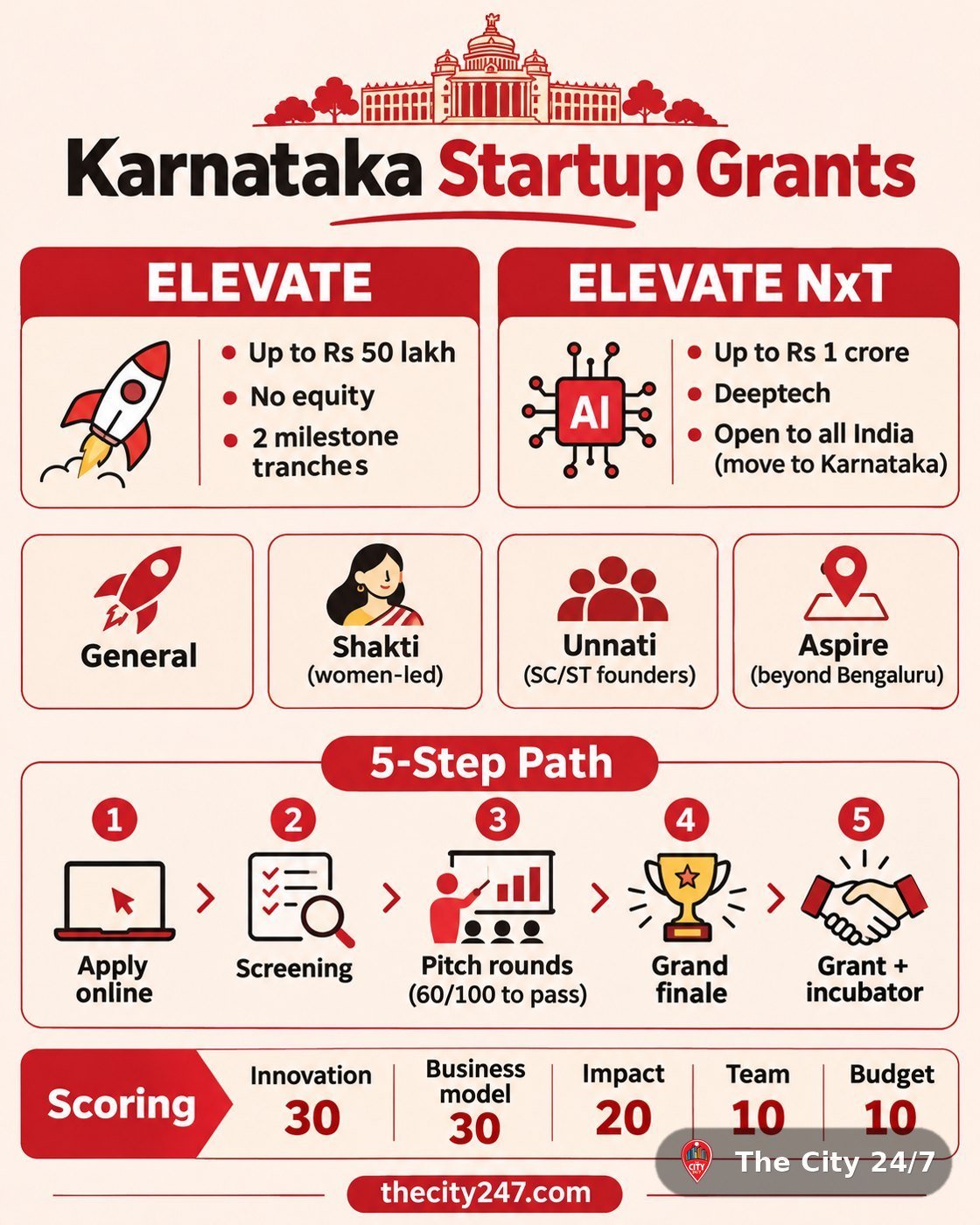
ELEVATE is a one-time, non-repayable grant of up to Rs 50 lakh from the Government of Karnataka for early-stage startups at the prototype, proof-of-concept or early commercialisation stage. It takes no equity. The money is paid in two equal tranches: the first after a tripartite agreement between KITS, an assigned incubator or innovation partner and the startup, and the second after your first milestone review.
Selected startups are also connected to subsidised incubation and mentoring through the state's network of K-Tech innovation partners. Note that the total you can receive across all ELEVATE calls is capped at Rs 50 lakh, so think about which call suits you best before you apply.
My take: treat ELEVATE as your bridge between friends-and-family money and your first proper investor. Rs 50 lakh with no dilution buys you a prototype, a pilot and a much better valuation.
What Are the Four ELEVATE Tracks?
In 2026, for the first time, all four ELEVATE tracks ran together. They share the same core rules but target different founders, and each track has its own eligibility criteria.
- ELEVATE (general): Open to eligible startups registered in Karnataka, across sectors.
- ELEVATE Shakti: For women-led startups with at least 51 percent women ownership. It used to be called ELEVATE Women.
- ELEVATE Unnati: For startups founded by entrepreneurs from Scheduled Caste and Scheduled Tribe communities.
- ELEVATE Aspire: For startups registered outside Bengaluru Urban, in Karnataka's tier-2 and tier-3 cities. It used to be called ELEVATE Beyond Bengaluru.
There is also ELEVATE Minorities, a grant of up to Rs 50 lakh for Karnataka startups where founders from recognised minority communities hold at least 51 percent equity, with a digital minority certificate from the Karnataka Revenue Department.
What Is ELEVATE NxT, and Who Can Apply?
ELEVATE NxT is Karnataka's deeptech grant programme, offering up to Rs 1 crore per startup in milestone-linked grant-in-aid, plus mentorship and ecosystem support. Unlike regular ELEVATE, it is open to startups from anywhere in India, but those registered outside Karnataka must move their registered office to the state within four months of the results.
- Age and size: Incorporated within the previous 20 years, with turnover of no more than Rs 300 crore in any year, and at least two employees.
- Stage: Technology readiness levels 3 to 8, with evidence such as a proof of concept, prototype or scientific validation.
- Deeptech case: A short statement explaining why your venture qualifies as deeptech.
- Sectors: The 2026 finalists came from AI and machine learning, quantum, spacetech, healthtech, cleantech and mobility.
The first round was competitive: 983 startups applied, 661 were shortlisted for in-person pitches and 256 reached the grand finale. The 2026 to 27 call, announced in October 2026, closed on 13 November.
“Deeptech founders, take note: Karnataka will pay up to Rs 1 crore for you to move your registered office here. That is the most generous relocation package in Indian tech.”
Who Is Eligible for Startup Karnataka Grants?
In general, you need to be a registered entity, such as a private limited company, LLP, one-person company or registered partnership, that meets the call's age and turnover limits, and you need an innovative product or service at prototype stage or beyond. For the regular ELEVATE tracks, that has meant 10 years or younger and turnover of up to Rs 200 crore, and registration in Karnataka.
- Registered entity: An idea on a slide is not enough. Incorporate first.
- Karnataka registration: For regular ELEVATE tracks, your startup must be registered in Karnataka.
- Innovation: A genuinely new product, process or business model, not a reseller or a services agency.
- Independence: Not a subsidiary of a larger company, and not funded by ELEVATE in the recent past (NxT bars startups funded by ELEVATE in the preceding three years).
- DPIIT recognition: Not always mandatory, but recommended. It strengthens your application and unlocks central benefits too.
How Does the ELEVATE Selection Process Work?
You apply online, get screened for eligibility, pitch to a jury and, if you score high enough, pitch again at a grand finale. Startups from Bengaluru Urban go through an additional pitch deck evaluation by a three-member jury, and applicants statewide pitch in multi-city rounds, where you need at least 60 out of 100 to advance.
- 1. Apply online: Fill in the application on the official ELEVATE portal with your company details, product, traction and budget.
- 2. Screening: A programme management unit checks legal eligibility, age, turnover and ownership.
- 3. Pitch rounds: A pitch deck review for Bengaluru Urban applicants, then multi-city pitching across Karnataka.
- 4. Grand finale: Startups that clear the 60-mark cut-off pitch to the final jury.
- 5. Sanction: Grant sanction, the tripartite agreement and onboarding with an incubator and mentors.
The scoring weights tell you exactly what the jury cares about: novelty and innovation (30), business model (30), socio-economic impact (20), team strength (10) and budgetary allocation (10).
How Do I Write a Winning ELEVATE Application?
Write to the scoring sheet. Sixty percent of the marks go to innovation and the business model, so spend sixty percent of your effort there. Be specific about what is new, who pays, how much and why now, and show a realistic budget for how you will spend the grant.
- Lead with the problem: One crisp paragraph on who has the problem and what it costs them today.
- Show proof: Prototype photos, pilot results, letters of intent, early revenue. Evidence beats adjectives.
- Explain the impact: Jobs, access, sustainability or reach beyond Bengaluru all score under socio-economic impact.
- Budget honestly: Map every rupee to a milestone. A padded budget is the quickest way to lose the jury.
- Rehearse the pitch: You will have only a few minutes. Practise until you can do it without slides.
What Is the Karnataka Startup Policy 2025 to 2030?
It is the state's five-year plan for startups, approved by the Karnataka Cabinet in late 2025, with an outlay of over Rs 500 crore and a target of 25,000 new startups by 2030, including 10,000 outside Bengaluru. It puts extra focus on deeptech, on founders from beyond Bengaluru and on grants like ELEVATE, so expect more calls and more tracks over the next few years.
Where Can I Get Incubation and Mentoring Support in Karnataka?
Through the state's K-Tech innovation network, which includes government-backed incubators, centres of excellence and innovation hubs across the state, plus university and private incubators in Bengaluru. ELEVATE winners are mapped to an incubator as part of the grant, but you do not need to wait to win: joining an incubator before you apply often makes your application much stronger.
- Government-backed: K-Tech centres of excellence and innovation hubs, and incubators in engineering colleges across Karnataka.
- Academic: Incubators at IISc and other leading institutes in Bengaluru, particularly strong for deeptech.
- Private: Accelerators, corporate programmes and coworking-based incubators across the city.
- Central schemes: Startup India's Seed Fund Scheme, accessed through approved incubators, can complement a state grant.
Startup Karnataka Grants: Frequently Asked Questions
How much is the ELEVATE grant in Karnataka?
Up to Rs 50 lakh for the ELEVATE tracks, paid in two milestone-linked tranches. ELEVATE NxT, the deeptech programme, offers up to Rs 1 crore. Neither takes equity.
Is ELEVATE open now?
The 2026 general call closed on 15 July 2026, and the ELEVATE NxT and ELEVATE Minorities calls closed on 13 November 2026. Watch the Department of Electronics, IT, BT and S&T's website for the next call.
Do I need DPIIT recognition to apply for ELEVATE?
It is not always listed as mandatory, but it is recommended and can strengthen your application. Check the specific call notice.
Can a startup outside Bengaluru apply?
Yes, and there is a dedicated track, ELEVATE Aspire, for startups registered outside Bengaluru Urban. The state's startup policy aims to create 10,000 startups outside Bengaluru by 2030.
Can a startup from another state apply?
For regular ELEVATE tracks, the startup must be registered in Karnataka. ELEVATE NxT is open to startups from across India, but they must move their registered office to Karnataka within four months of the results.
Does the Karnataka government take equity in ELEVATE startups?
No. ELEVATE is a non-dilutive grant-in-aid. The state does not take any shares in your company.
How are ELEVATE applications scored?
Novelty and innovation (30), business model (30), socio-economic impact (20), team strength (10) and budgetary allocation (10). You need at least 60 out of 100 in the multi-city pitch round to reach the finale.
Can I apply to ELEVATE more than once?
You can apply to different calls, but the total grant you can receive across all ELEVATE calls is capped at Rs 50 lakh, and NxT excludes startups that received ELEVATE funding in the preceding three years.
Official Sources
Always read the latest call notice on the government's own website before you apply. Third-party summaries, including this one, can go out of date.
Applying for ELEVATE? Tell Me About Your Startup
Building something in Bengaluru, or beyond, and planning to apply for the next ELEVATE call? Click the WhatsApp icon at the bottom right of your screen and tell me what you are working on. That is also the quickest way to reach The City 24/7 about anything at all.
Want the next grant call, funding news and the city's best startup events in your inbox? Join our ever-growing community at thecity247.com/newsletter.
Same city, new stories, always.

Related Stories
 BUSINESS
GST Registration in Bangalore: The Free Government Form Everyone Pays Someone to Fill
November 6, 2026
 BUSINESS
Bangalore's Business Districts Explained: Who Is Where, and What It Costs
July 31, 2026
 BUSINESS
Bangalore for Entrepreneurs: The Networks, Resources and Real Costs
July 31, 2026
 BUSINESS
Bangalore's Startup Ecosystem: A Complete Guide to Plugging Into It
July 28, 2026
 BUSINESS
Business Networking in Bangalore: Which Rooms Are Worth Your Time
July 27, 2026
 BUSINESS
How Much Does It Cost to Run a Business in Bangalore? Three Worked Budgets
July 27, 2026
