



“A free certificate that makes banks friendlier and late payers nervous is the best bargain in Indian business.”
• Tariq Sallam, on the paperwork most founders skip
Every week someone in Bengaluru messages me some version of the same question: "Bro, should I get MSME registration? A guy is charging Rs 2,500 for it." The answer is yes, you should, and no, you should not pay the guy. Udyam registration, which is the official name for MSME registration since July 2020, is free, runs on one government portal and takes about as long as a filter coffee if your Aadhaar, PAN and GST details are in order.
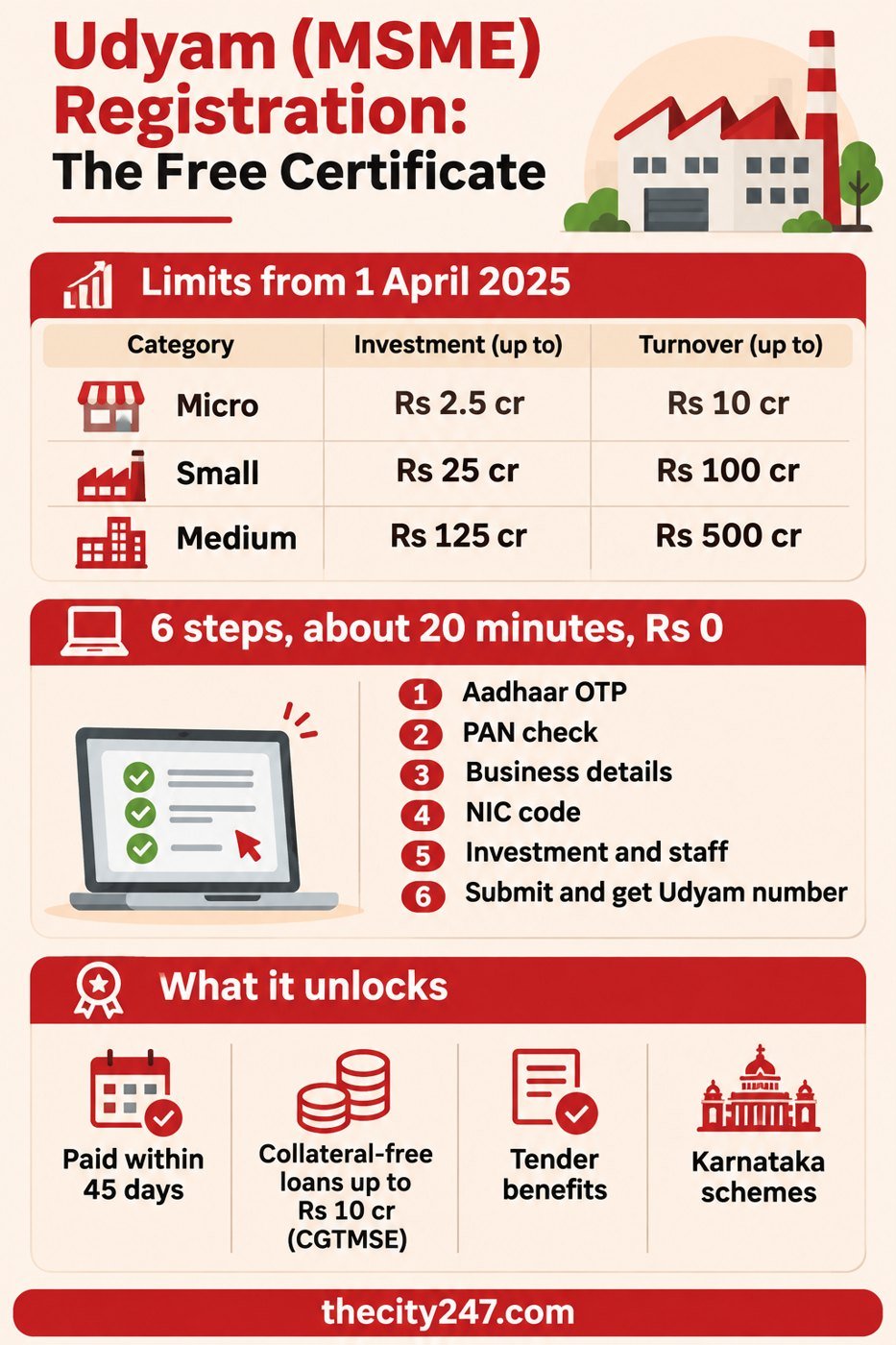
What makes it worth the twenty minutes is what it unlocks afterwards. Collateral-free loans under the credit guarantee scheme, a legal 45-day payment deadline that your big corporate clients actually fear because of the income tax rules, priority in government tenders, cheaper bank loans that count as priority sector lending, and a gateway to Karnataka's own subsidies under the Industrial Policy 2025-30. If you run a bakery in Basavanagudi, a design studio in Indiranagar or a fabrication unit in Peenya, this certificate is the entry ticket.
In this guide I walk you through who qualifies under the revised 2025 limits, the exact online steps, the mistakes that cause headaches later, and which central and Karnataka schemes become available once you have that Udyam number. No jargon where plain English works, and a few opinions where I think the official line is too polite.
Quick Information
It costs nothing, needs no documents uploaded and no officer to meet. Naturally, half of Bengaluru still pays an agent to do it.
What Is Udyam Registration and Is It the Same as MSME Registration?
Yes, Udyam registration is MSME registration. It is the single online registration that the Ministry of Micro, Small and Medium Enterprises uses to recognise your business as a micro, small or medium enterprise under the MSMED Act, 2006. It replaced the older Udyog Aadhaar Memorandum (UAM) on 1 July 2020, and old UAM numbers are no longer valid for claiming benefits.
The idea is simple: one Aadhaar-linked, PAN-linked identity that every bank, government department and big buyer can check online. The portal pulls your investment and turnover from the Income Tax and GST systems, so there is no certificate from a chartered accountant, no physical verification and nothing to upload.
For scale: the official portal showed about 5.42 crore enterprises on Udyam and another 4.32 crore on the Udyam Assist Platform as of 1 October 2026. That is roughly 9.7 crore businesses. If you are not on it yet, you are the minority.
If you sell goods or services and have a PAN, register. Even if you are a one-person consultancy working from a 1BHK in HSR Layout. Especially then, actually, because you are the one most likely to be paid late.
Who Qualifies as Micro, Small or Medium in 2026?
You qualify based on two numbers, investment in plant and machinery or equipment, and annual turnover, and you must stay within BOTH limits for a category. The limits were raised from 1 April 2025, roughly 2.5 times for investment and 2 times for turnover, and these are the ones that apply now.
- Micro: investment up to Rs 2.5 crore and turnover up to Rs 10 crore.
- Small: investment up to Rs 25 crore and turnover up to Rs 100 crore.
- Medium: investment up to Rs 125 crore and turnover up to Rs 500 crore.
Two details trip people up. First, export turnover is left out when your turnover is counted, so an exporter can stay micro or small even with bigger total sales. Second, investment means plant, machinery and equipment at written-down value from your ITR, not land, buildings or furniture. So the Rs 3 crore floor you bought in Electronic City does not push you out of micro.
Can traders, freelancers and service businesses register?
Yes, with one catch for traders. Manufacturers and service providers (consultants, agencies, clinics, IT firms, salons, restaurants) register as normal. Retail and wholesale traders have been allowed on Udyam since July 2021, but only for priority sector lending, which mainly helps with bank loans. Several other benefits, including the delayed-payment protection, are meant for manufacturing and service enterprises, so a pure trader should not count on them.
How Do I Register on the Udyam Portal, Step by Step?
You register in one sitting on udyamregistration.gov.in under "For New Entrepreneurs who are not Registered yet as MSME". Keep your Aadhaar-linked mobile phone next to you, because two OTPs are coming.
- Step 1, Aadhaar: Enter the Aadhaar number and name of the proprietor (for a proprietorship), managing partner (partnership), karta (HUF) or authorised director (company or LLP). Validate with the OTP.
- Step 2, type of organisation and PAN: Pick your constitution and enter the business PAN. The portal checks it against the Income Tax database. A company or LLP needs its own PAN, not the director's.
- Step 3, business details: Name of the enterprise, plant or office address, official address, date of incorporation or commencement, bank account and IFSC, and your GSTIN if you have one.
- Step 4, activity and NIC code: Choose manufacturing or services, then select the National Industrial Classification (NIC) codes that describe what you actually do. You can add more than one.
- Step 5, employees and investment: Enter employee numbers. Investment and turnover are pre-filled from ITR and GST data where available; for a brand-new business you self-declare.
- Step 6, submit: Tick the declaration, get the final OTP and submit. Your Udyam Registration Number appears on screen, and the e-certificate follows by email.
Read the NIC codes out loud. If you run a cloud kitchen and picked "manufacture of bakery products" because it was the first result, banks and schemes will treat you as a bakery factory. Fixing it later is possible but annoying.
What if I do not have a PAN or GSTIN yet?
Then you use the Udyam Assist Platform, not the main portal. UAP was built in January 2023 for informal micro enterprises such as street vendors, home businesses and small artisans who are outside GST. You register through a designated agency (banks, NBFCs, SIDBI and certain other bodies) using Aadhaar and a mobile number, and the RBI treats a Udyam Assist Certificate as micro for priority sector lending. Once you get a PAN and grow, move to full Udyam registration.
What Documents Do I Need for Udyam Registration?
You need details rather than documents, because nothing is uploaded. Keep these handy before you start so you do not end up hunting for a cancelled cheque halfway through.
- Aadhaar: of the proprietor, partner, karta or authorised signatory, with the linked mobile number working.
- PAN: of the business entity (for a proprietorship, the owner's PAN).
- GSTIN: if your business is required to be GST registered. If you are below the threshold and exempt, you can still register.
- Bank details: account number and IFSC of the business account.
- Address and dates: registered and operating addresses, and the date you started or incorporated.
- Activity: a clear idea of your NIC codes and the number of people you employ.
If you are still at the stage of choosing between proprietorship, LLP or a private limited company, sort that first. My guide to registering a business in Bangalore covers that decision and the costs, and the GST guide explains when GST becomes compulsory.
What Are the Real Benefits of Being Udyam Registered?
The biggest practical benefits are faster payments from big buyers, collateral-free credit and better treatment in tenders. Here is what actually changes on the ground once you have the number.
The 45-day payment rule and Section 43B(h)
Under Section 15 of the MSMED Act, a buyer must pay a micro or small supplier within the agreed period, which can never exceed 45 days, or within 15 days if nothing was agreed. Pay late and the buyer owes compound interest at three times the RBI bank rate. Since the 2024-25 assessment year, Section 43B(h) of the Income Tax Act adds a sharper edge: a buyer cannot claim the expense as a deduction in that year if a payment to a registered micro or small enterprise is overdue at year end. Suddenly the finance team of a large company in Whitefield cares a lot about paying you on day 44.
Print your Udyam number and the category (micro or small) on every invoice and in your vendor form. The protection only bites if the buyer knows you are an MSE.
Collateral-free loans and cheaper credit
Loans to registered MSMEs count towards banks' priority sector targets, which is why banks actively chase them. Under the Credit Guarantee Fund Trust for Micro and Small Enterprises (CGTMSE), banks can lend without collateral or a third-party guarantee, and the Union Budget 2025-26 raised the guarantee cover for micro and small enterprises from Rs 5 crore to Rs 10 crore. The same budget announced customised credit cards of up to Rs 5 lakh for micro enterprises registered on Udyam; ask your bank whether it is issuing them yet.
Government tenders and the TReDS platforms
Central ministries and public sector units must source at least 25 percent of their annual procurement from micro and small enterprises. Registered MSEs commonly get exemptions from tender fees and earnest money deposits, and GeM (Government e-Marketplace) uses your Udyam data. The portal also nudges you to join TReDS platforms such as RXIL, M1xchange and InvoiceMart, where you can sell your invoices to banks and get paid in days instead of waiting for the buyer.
The smaller perks people forget
- Subsidised certifications: support for ISO, BIS and ZED certification, and for patents and trademarks under central schemes.
- Electricity and state concessions: many state schemes, including Karnataka's, require Udyam as the starting document.
- Credibility: corporate vendor onboarding forms increasingly ask for it, and some will not process you without it.
Which Karnataka Schemes Does Udyam Registration Unlock?
In Karnataka, Udyam is the starting document for almost every state MSME incentive, administered through the Department of Industries and Commerce and the District Industries Centres (DIC). The current framework is the Karnataka Industrial Policy 2025-30, unveiled in February 2025 with a target of Rs 7.5 lakh crore in investment and 20 lakh jobs.
Here is the honest Bengaluru angle: the policy divides the state into zones, and the richest incentives go to backward districts. Capital investment subsidies for MSMEs are highest in Zone 1 districts and smallest, or limited, around Bengaluru. If you are setting up a factory and have flexibility, a unit in Tumakuru or Kolar may get you far more support than one in Peenya. If you are a Bengaluru service business, the state capital subsidy will matter less than the central credit and payment benefits above.
- Capital and interest subsidies: zone-based investment promotion subsidies and interest subsidies on term loans, mainly for manufacturing units. Confirm the current rates and your zone with DIC before you plan around them.
- Stamp duty and registration concessions: for land and lease deeds of eligible units, plus reimbursement of some land conversion costs.
- KSFC loans: Karnataka State Financial Corporation offers term loans to MSMEs, with special schemes for first-generation, women and SC/ST entrepreneurs.
- PMEGP: the central Prime Minister's Employment Generation Programme gives a margin money subsidy of roughly 15 to 35 percent of project cost for new micro units, applied for online through KVIC, KVIB or DIC.
- Delayed payment cases: Karnataka's Micro and Small Enterprises Facilitation Council (MSEFC) hears cases filed on the MSME Samadhaan portal.
For Bengaluru Urban, the District Industries Centre is the office that guides you on state schemes and PMEGP. Call before you go, carry your Udyam certificate, and ask specifically which schemes your zone and activity qualify for.
What Mistakes Should I Avoid With Udyam Registration?
The most expensive mistake is paying a fake website, and the second is getting the details wrong and forgetting about them. Here is my list of the classics I see founders make.
- Paying a lookalike site: the Ministry has repeatedly warned about private sites that look official and charge for "MSME certificates". The official portal says in plain words that registration is free.
- Registering twice: one PAN gets one Udyam registration. Add new activities or units to the same registration instead of creating a second one.
- Wrong NIC codes: they decide whether you are treated as manufacturing or services and which schemes apply.
- Using a personal PAN for a company: a private limited company or LLP must register with its own PAN.
- Ignoring the old Udyog Aadhaar: if you only ever had a UAM number, register afresh on Udyam. The old number does not carry benefits now.
- Not updating changes: new address, new bank account or a change in ownership? Log in with your Udyam number and Aadhaar OTP and update it online.
How Do I Update, Print or Cancel My Udyam Certificate?
You do all three on the same portal using your Udyam Registration Number and the OTP sent to the registered mobile or email. There is no annual renewal and no fee. Your classification is refreshed from your ITR and GST data, so if your business grows from micro to small, the portal reflects it after the returns are filed.
- Print or re-download: use the print certificate option on the portal.
- Update details: use the update details option for address, bank, activity, NIC codes or contact changes.
- Cancel: the update section also lets you cancel registration, for example when you close the business or convert to a company that registers with its own PAN.
Udyam (MSME) Registration in Bangalore: Frequently Asked Questions
Is Udyam registration free?
Yes. Registration on udyamregistration.gov.in is completely free. Any website or agent charging a fee for the certificate itself is not the government; at most they are charging for their time.
How long does Udyam registration take?
About 15 to 30 minutes online if your Aadhaar, PAN, GST and bank details are ready. The registration number is generated on submission and the certificate is emailed.
Is MSME registration mandatory?
It is not compulsory to run a business, but you need it to claim almost every MSME benefit: the 45-day payment protection, collateral-free CGTMSE loans, priority sector lending, tender benefits and Karnataka's state incentives.
Can a freelancer or consultant get Udyam registration?
Yes. Freelancers and consultants register as service enterprises using their own PAN and Aadhaar and the right NIC code. Many do it mainly for the payment protection with large clients.
Is GST required for Udyam registration?
Only if your business is legally required to have GST. Businesses exempt from GST can register without a GSTIN. Informal micro units with no PAN can use the Udyam Assist Platform instead.
What are the MSME limits in 2026?
Micro: investment up to Rs 2.5 crore and turnover up to Rs 10 crore. Small: Rs 25 crore and Rs 100 crore. Medium: Rs 125 crore and Rs 500 crore. Both limits must be met, and export turnover is excluded.
Do I need to renew my Udyam certificate every year?
No. The registration is permanent. Classification updates automatically from your ITR and GST data, and you update other details online yourself.
Does Section 43B(h) apply to traders?
Generally no. Section 43B(h) follows the MSMED Act's payment rules, which cover micro and small manufacturing and service enterprises. Traders registered for priority sector lending should not rely on it; check with your CA.
Official Portals and Offices
Stick to these official channels. Everything on this list is free to use, which is more than can be said for the lookalikes.
Got a PAN and Twenty Minutes? Get Your Udyam Number Today
Open udyamregistration.gov.in, keep your phone close and finish it before lunch. Then print the number on your next invoice and watch how differently the accounts payable team replies to your emails.
Stuck on an NIC code, a PAN mismatch or a client who still pays in 90 days? Click the WhatsApp icon at the bottom right of your screen and tell me what is going on. That is the quickest way to reach The City 24/7 about anything at all.
And if you want one useful Bengaluru business or city guide in your inbox every week, join us at thecity247.com/newsletter.
This guide is general information, not legal or tax advice. Rules, limits and schemes change, so confirm on the official portals or with your chartered accountant before you act. Same city, new stories, always.

Related Stories
 BUSINESS
GST Registration in Bangalore: The Free Government Form Everyone Pays Someone to Fill
November 6, 2026
 BUSINESS
How to Register a Business in Bangalore: Every Step, Cost and Licence
July 27, 2026
 BUSINESS
Coworking in Bangalore: Where to Sit, What It Costs and What to Check First
July 8, 2026
 BUSINESS
Bangalore's Business Districts Explained: Who Is Where, and What It Costs
July 31, 2026
 BUSINESS
Bangalore for Entrepreneurs: The Networks, Resources and Real Costs
July 31, 2026
 BUSINESS
Accountants, Recruiters, Consultants and Printers in Bangalore: What to Pay and How to Choose
July 31, 2026
