


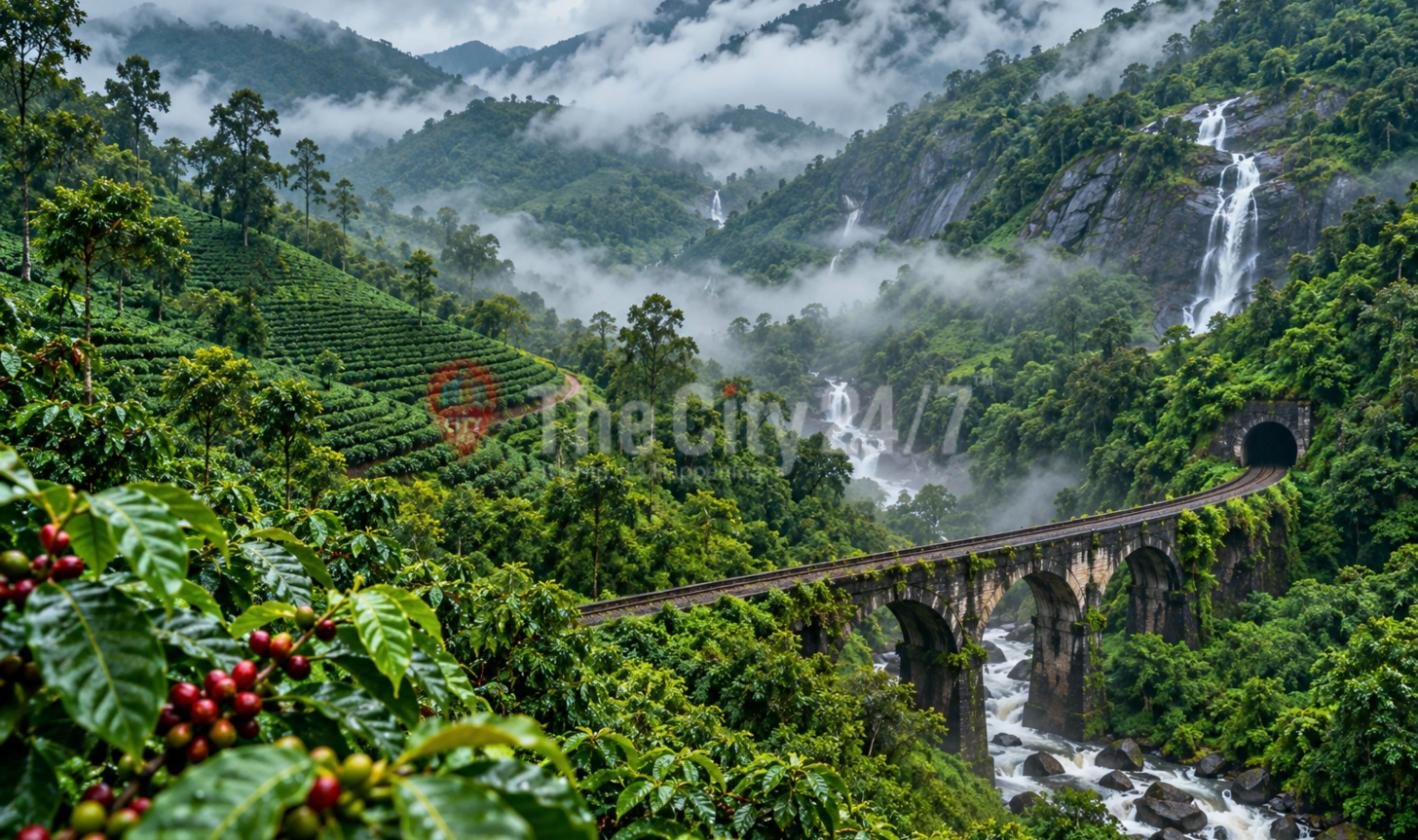
“Most places near this city are worse in the rain. Sakleshpur is the one place that is only really itself in the rain.”
• Why this trip is different
Sakleshpur is about 220 km from Bangalore, a four and a half hour drive via Hassan on NH75, and it is the best monsoon destination within a weekend of this city. The two things to see are Bisle Ghat viewpoint and Manjarabad fort, the right season is June to September, and you should stay at an estate homestay. Budget Rs 7,000 to 11,000 per person for two nights.
Sakleshpur, or Sakleshpura, sits in Hassan district right on the edge of the Ghats, where the plateau drops away towards the coast. It gets serious rain, and that single fact shapes everything: the coffee, cardamom and pepper estates, the waterfalls that appear everywhere in July, and the fact that the town is busiest in the months when everywhere else empties out.
It is also less developed than Coorg or Chikmagalur, with fewer sights and fewer people, which is the point. This guide covers the route, what to see, the railway trail question, where to stay, and what monsoon travel here actually involves.
Quick Information
A quirky little corner of Karnataka that is genuinely at its best when the weather is at its worst.
How Far Is Sakleshpur From Bangalore and How Do You Get There?
About 220 km, and four and a half hours via Nelamangala, Kunigal, Channarayapatna and Hassan on NH75. Uniquely among the hill destinations near this city, Sakleshpur has its own railway station, which makes it the easiest of them to reach without a car.
- By car. NH75 all the way to Hassan, then about 40 km further west. Good road throughout, with the climb starting after Hassan.
- By train. Services to Sakleshpur on the Bengaluru to Mangaluru line via Hassan. Slow but scenic, and you arrive in the town itself.
- By bus. Frequent KSRTC services to Sakleshpur and Hassan, Rs 200 to 600. Simple and cheap.
- When to leave. Before 6.30 AM to clear Nelamangala, or Friday night. The junction is the bottleneck, not the highway.
- Once there. You need a vehicle or a day hire for Bisle Ghat, which has no public transport at all. Autos and jeeps are available in town.
Sakleshpur having a railway station is genuinely the most useful fact in this guide. If you do not own a car, this is the Western Ghats hill town you can actually get to, and homestays will collect you from the station if you ask.
What Is There to See in Sakleshpur?
Bisle Ghat viewpoint and Manjarabad fort are the two that matter, and beyond them it is estates, waterfalls and rain. This is a small list by design. Sakleshpur is not a destination for sightseeing, it is a destination for being somewhere green and wet with very little to do.
- Bisle Ghat viewpoint. About 55 km from town through reserve forest, looking out across the Kumaradhara valley and three ranges of the Ghats. On a clear monsoon morning it is one of the best views in Karnataka. On a foggy one you will see nothing at all, which is part of the deal.
- Manjarabad fort, 6 km. A star-shaped fort built under Tipu Sultan, with a short climb up a flight of steps. Small, atmospheric and best at sunset.
- Magajahalli and Abbi falls. Local waterfalls that appear properly from July. Ask the homestay which are running and which are accessible.
- Estate walks. Coffee, cardamom and pepper. As in Coorg and Chikmagalur, the estate walk with the owner is the single best thing on offer.
- Kukke Subramanya, 70 km. A significant temple down the Ghats towards the coast, and a common add-on from this direction.
- Jenukallu Gudda. A trek with a viewpoint, and one of several local hikes that homestays can arrange with a guide.
Should You Do the Sakleshpur Railway Trek?
No. The so-called Green Route trek along the railway line between Sakleshpur and Subrahmanya Road runs on a live broad gauge track through tunnels and over bridges, and walking it is trespassing. There have been fatalities, the railways prohibit it, and people are prosecuted.
I mention it because it is still widely written about as an adventure and because you will see photographs. The trail is a working railway, with trains in tunnels where there is no room to stand aside. If you want a hard walk in this landscape, ask your homestay for a guided trek to Jenukallu Gudda or Ombattu Gudda instead, which are legal, guided and better.
“The railway trek is not a trail. It is a live line with tunnels you cannot step aside in. People have died doing it, and the fine is the least of your problems.”
• Said plainly, because it keeps being romanticised
Why Is Sakleshpur Best in the Monsoon?
Because it is one of the wettest inhabited parts of Karnataka, and the rain is the attraction rather than the obstacle. Between June and September the estates are saturated green, waterfalls appear in places that are dry the rest of the year, and the homestays are built around sitting on a verandah watching it come down.
- What you get. Mist through the coffee, rain on a tiled roof, hot food, waterfalls everywhere, and almost nobody else around.
- What you accept. Leeches on any walk, occasional power cuts, slippery rock, and the chance that Bisle Ghat shows you a wall of cloud.
- Leeches. Genuinely common here. Long trousers, socks over the trouser cuff, and a small pouch of salt. They are harmless and deeply unpleasant.
- Road risk. The Shiradi and Charmadi ghats below Sakleshpur can close for landslides in peak monsoon. That affects onward travel to the coast, not Sakleshpur itself.
- Rates. Thirty to forty percent lower than the winter season, which is the other reason to come.
Where Should You Stay in Sakleshpur?
An estate homestay, either around the town itself, along the Mudigere road, or out towards Bisle. The town has a few functional hotels and no reason to use them. The homestays here are generally smaller and more basic than in Coorg, and the food is often better for it.
- Around Sakleshpur town. Closest to the station and the fort, good for a trip without a car.
- Mudigere road. Higher coffee country towards Chikmagalur, with good estate properties.
- Bisle road. Remote, green and wonderful, with rough approach tracks. Ask about the road before booking.
- What to ask. Is the room detached, are meals included, what is the approach road like, will you collect from the station, and are there group bookings that weekend.
- Price bands. Rs 2,500 to 4,000 for a simple homestay, Rs 4,000 to 7,000 for a good one with meals, Rs 9,000 plus for a resort.
What Does a Sakleshpur Trip Cost?
Rs 7,000 to 11,000 per person for two nights at a homestay with meals, four people sharing a car. It is one of the cheaper hill weekends from Bengaluru, and the monsoon discount makes it cheaper still.
Two Nights, per Person
Four sharing a car, meals included.
When Is the Best Time to Visit Sakleshpur?
June to September if you want the version of Sakleshpur worth travelling for, and October to February if you would rather be comfortable and actually see the view from Bisle Ghat. Both are legitimate, and they are almost different destinations.
Season by Season
The only place on this site where I recommend the monsoon first.
What Should You Carry to Sakleshpur?
In the monsoon: a rain jacket rather than an umbrella, shoes you do not mind soaking, long socks, salt for leeches and a dry bag for a phone. Outside the monsoon, a fleece for the evenings is enough.
- Rain gear. A jacket with a hood. Umbrellas are useless on an estate walk in wind.
- Footwear. Two pairs, because one will be wet. Grip matters on wet laterite and rock.
- Leech kit. Long trousers, socks pulled over the cuffs, and a small pouch of salt.
- Torch. Power cuts are common in heavy rain, and estate paths have no lighting.
- Cash. ATMs exist in town but can be empty. Homestays often prefer cash or UPI, and connectivity is patchy.
- Offline maps. Mobile coverage vanishes on the Bisle road entirely.
FAQs
How far is Sakleshpur from Bangalore?
About 220 km, and four and a half hours via Nelamangala, Kunigal, Channarayapatna and Hassan on NH75. Sakleshpur also has its own railway station on the Bengaluru to Mangaluru line, which makes it the easiest Ghat hill town to reach without a car.
What is Sakleshpur famous for?
Rain, coffee, cardamom and pepper estates, and the Bisle Ghat viewpoint looking across three ranges of the Western Ghats. Manjarabad fort, a star-shaped Tipu-era fort six kilometres from town, is the other main sight.
What is the best time to visit Sakleshpur?
June to September for the full monsoon experience, with waterfalls, mist and rates 30 to 40 percent lower. October and November are the sweet spot, still green with the best visibility from Bisle Ghat. December to February is dry and comfortable with fewer waterfalls.
Is the Sakleshpur railway trek allowed?
No. The Green Route trek along the railway line between Sakleshpur and Subrahmanya Road runs on a live broad gauge track through tunnels where there is no room to step aside. It is trespassing, there have been deaths, and people are prosecuted. Ask your homestay for a guided trek instead.
How do I get to Bisle Ghat from Sakleshpur?
By vehicle only, about 55 km through reserve forest. There is no public transport, and mobile coverage disappears. Hire a car or jeep for the day at Rs 1,500 to 2,500, and go early in the morning for the best chance of a clear view.
Is Sakleshpur worth visiting in the monsoon?
It is the one destination near Bengaluru that is genuinely better in the rain. Expect saturated green estates, waterfalls everywhere, almost no other visitors and low rates. Expect also leeches on every walk, power cuts, and a real chance that Bisle Ghat is fogged in.
Where should I stay in Sakleshpur?
An estate homestay, either near the town for station access, along the Mudigere road for higher coffee country, or out towards Bisle for remoteness. Properties here are smaller and more basic than in Coorg, and the home-cooked food is usually better for it.
Can I combine Sakleshpur with other destinations?
Yes. Belur and Halebidu are about 60 km away and sit on the drive home, Chikmagalur is a similar distance north, and Kukke Subramanya temple is 70 km down the Ghats. A three-night trip covering Sakleshpur and the Hoysala temples works very well.
Contact Details
Official sources for forest permissions, road conditions and rainfall, all of which matter more here than elsewhere.
Been in the Rain?
If you know a homestay around Sakleshpur that gets the monsoon right, or a legal guided trek worth recommending, click the WhatsApp icon at the bottom right of your screen and tell me. I will go in July and write it up. That is also the easiest way to reach The City 24/7 about anything at all.
And if you want stay picks, getaway ideas and trail notes in your inbox, join our ever growing community at thecity247.kit.com/join-the-community. Free, ten seconds.
Same city, new stories, always.

Related Stories
 TRAVEL
Chikmagalur From Bangalore: The Complete Guide to Karnataka's Best Coffee Weekend
September 16, 2026
 TRAVEL
Coorg From Bangalore: The Complete Guide to Getting It Right
September 16, 2026
 TRAVEL
Hampi From Bangalore: The Complete Guide to the Best Thing Within a Weekend of This City
September 16, 2026
 TRAVEL
Mysore From Bangalore: The Complete Guide to the Best Trip This City Has
September 16, 2026
 TRAVEL
Wayanad From Bangalore: The Complete Guide to Crossing Into Kerala for a Weekend
September 16, 2026
 TRAVEL
The Best Beaches to Visit From Bangalore, and the Honest Truth About the Distance
September 16, 2026
