

“Visvesvaraya gave Bangalore its engineering brain. Mirza Ismail made sure the city looked good while using it.”
• Tariq Sallam, on the Diwan most Bengalureans have never heard of
Walk past Town Hall on JC Road, look up at a heritage lamp post, or land at the old HAL airport, and you are brushing against the legacy of a man whose name almost nobody in Bengaluru says out loud anymore. Jaipur has a whole famous road named after him. Bengaluru, the city where he was born and where he died, mostly just has his buildings.
Sir Mirza Ismail was Diwan, effectively the prime minister, of the princely state of Mysore from 1926 to 1941. In those fifteen years he pushed factories, power and new extensions, but he also had an almost fussy obsession with gardens, roads, lighting and tidiness. He believed a modern city should be productive and beautiful at the same time, which is a sentence I would like to frame and post to a few civic offices.
This is my People of Bangalore profile of Sir Mirza Ismail: where he came from, how a police officer became Diwan, what he built in Bangalore, the Jaipur and Hyderabad chapters, the criticism, and where you can still see his fingerprints in the city today.
Quick Information
A Bangalore-born Diwan who built factories by day and fretted about flowerbeds by night. Three princely states hired him. Two named things after him.
Who Was Sir Mirza Ismail?
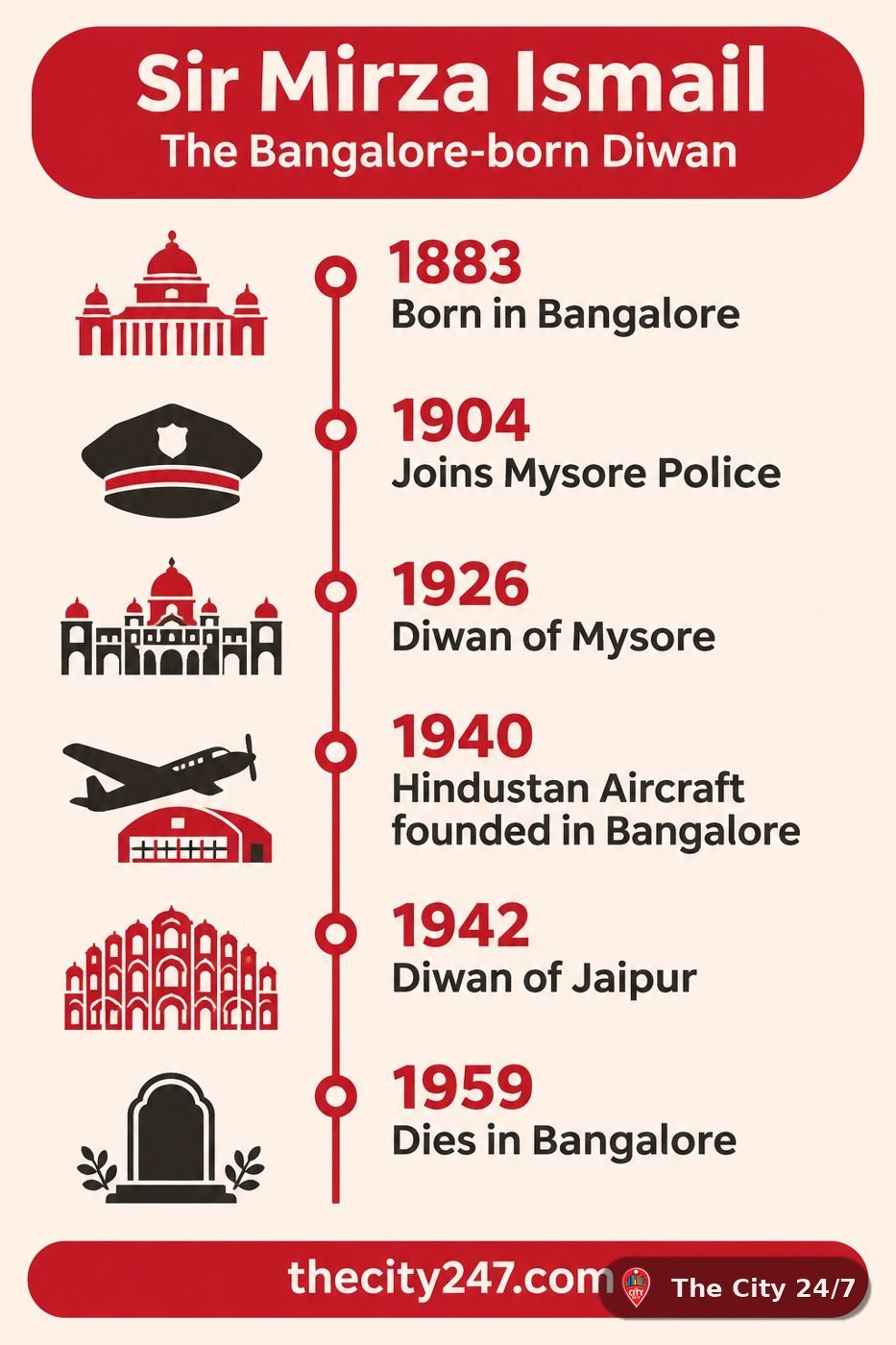
Sir Mirza Ismail was a Bangalore-born administrator who served as Diwan of Mysore from 1926 to 1941 and is remembered for modernising the state while insisting its cities be beautiful. He was born on 24 October 1883 in Bangalore, into a family of Persian descent that had been tied to the Mysore court for two generations.
The family story goes like this. His grandfather, a Persian trader, came to India in the 1820s, found shelter under the Maharaja of Mysore and supplied horses for the royal stables. His father rose to be a long-serving official in the Mysore administration. So young Mirza grew up inside the world of the Mysore state, not as an outsider who arrived to run it.
What I love about this is the local angle. We often think of Diwans as polished imports from Madras or Bombay. Mirza Ismail was a Bangalore boy, studied here, and came home to Bangalore at the end of his life.
How Did Mirza Ismail Know the Maharaja?
He was a childhood friend and classmate of Krishnaraja Wadiyar IV, the Maharaja who would later appoint him, and that friendship shaped his whole career. Accounts say the two studied together in the palace school, and the bond lasted for decades.
Sources differ on the rest of his schooling. One version has him graduating from St Patrick's in Bangalore in 1904; another names St Patrick's and Wesleyan schools and then Central College. Either way, he was educated in the city and joined the Mysore service in 1904 as an Assistant Superintendent of Police.
- Police officer: he started in the Mysore police in 1904.
- Private secretary: he then became private secretary to the Maharaja, which put him at the centre of the state's decision-making.
- Mentored by Visvesvaraya: the Maharaja is said to have asked Sir M. Visvesvaraya, the great engineer and former Diwan, to guide him.
- Diwan at 43: on 1 May 1926 he became Diwan of Mysore, reportedly on Visvesvaraya's recommendation.
“Imagine your school friend becomes king and then makes you prime minister. That is either the best or the most stressful class reunion in history.”
What Did Mirza Ismail Do for Bangalore?
As Diwan, Mirza Ismail pushed new industries into Bangalore, extended the city and, unusually for the time, made beauty part of the plan. His period saw the porcelain and glass factories set up in Bangalore, Hindustan Aircraft founded here in 1940, and new residential extensions laid out.
Factories and the Aircraft Company
The Mysore state under Mirza Ismail was busy starting things: porcelain and glass works in Bangalore, and across the state paper, cement, steel, fertiliser, sugar and electric bulb factories. The headline act came in December 1940, when Hindustan Aircraft was set up in Bangalore by the industrialist Walchand Hirachand with the Mysore government as a backer. That company became today's Hindustan Aeronautics Limited, still one of the biggest employers and landmarks in the east of the city.
- Porcelain factory: set up in Bangalore during his tenure, producing insulators and ceramics.
- Glass factory: also in Bangalore.
- Hindustan Aircraft, 1940: founded in Bangalore in his final years as Diwan; later Hindustan Aeronautics Limited (HAL).
- Rural electrification: Mysore is often credited with India's first rural electrification programme in this period.
Extensions and Neighbourhoods
He is credited with developing new areas such as Wilson Garden, Kalasipalyam and Gandhi Colony as the city grew in the 1920s and 1930s. If you live in or around these today, your street plan has a little Mirza Ismail in it.
The Town Hall
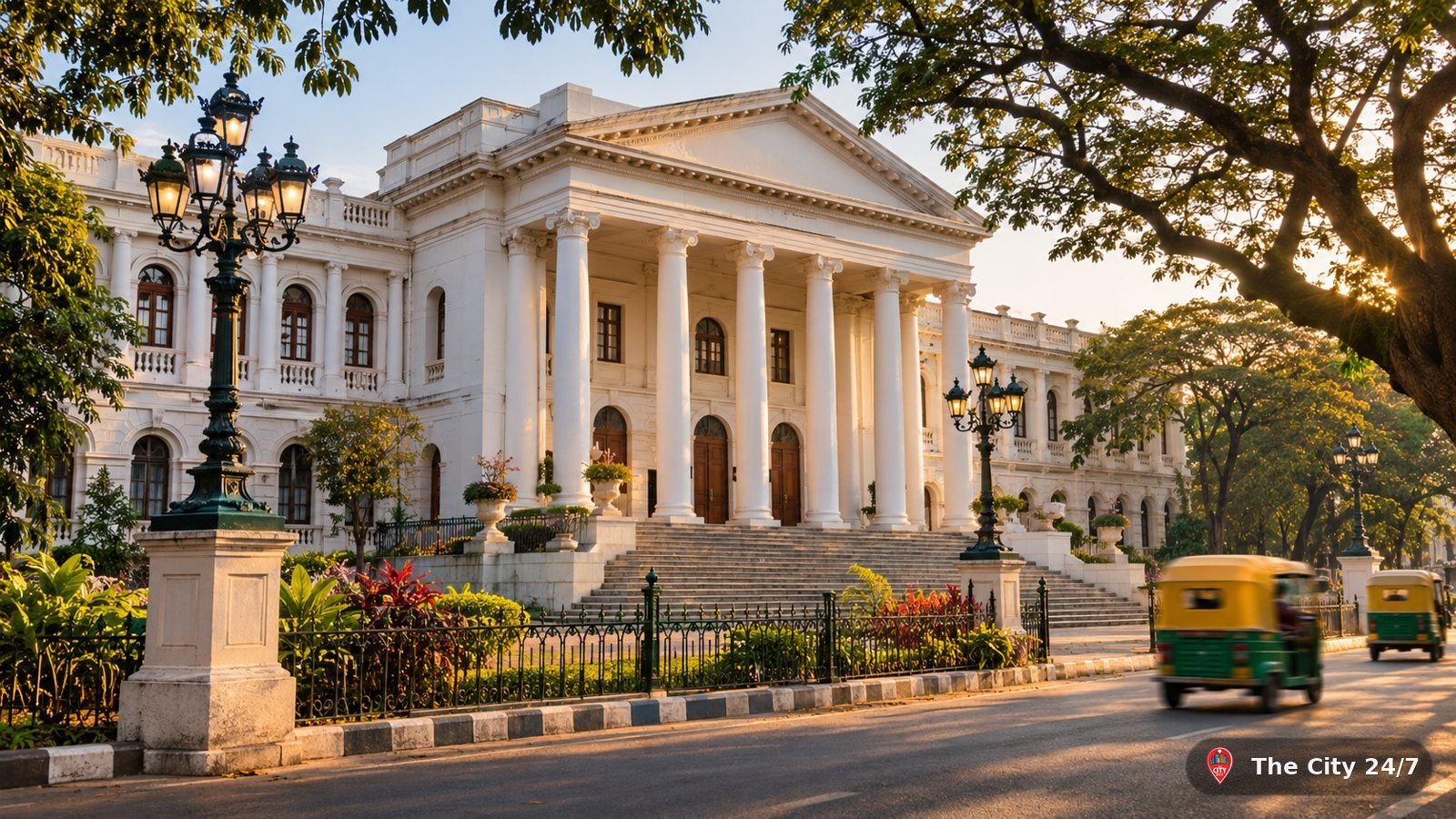
Bangalore's Town Hall, now the Sir Puttanna Chetty Town Hall on JC Road, was built in the 1930s during Mirza Ismail's time as Diwan. Sources disagree on his exact role: one credits him with its design, another with building it, while the Yuvaraja is named as the one who commissioned it. What is clear is that the building belongs to his era of confident, classical public architecture.
Why Is Mirza Ismail Linked to Beautiful Cities?
Because he treated beauty as a basic part of administration, not a luxury. Histories of his tenure describe a Diwan who wanted parks, clean roads, good lighting and graceful buildings, and who would personally check that things were done properly.
- Lamp-lit streets: Bangalore's streets and Lalbagh were lit with ornamental lamp posts in his time.
- Gardens: he is credited with developing many parks and gardens in the state, including the famous Brindavan Gardens below the KRS dam near Mysuru.
- Hands-on inspections: a well-known anecdote has him lifting a carpet to check whether the floor beneath had been swept.
“A Diwan who lifted carpets to check for dust. Somewhere, every Bengaluru ward office just felt a cold shiver.”
What Did He Do After Mysore?
After resigning as Diwan of Mysore in 1941, over differences with the new court after Krishnaraja Wadiyar IV's death in 1940, he went on to serve as Diwan of Jaipur and then as Prime Minister of Hyderabad. Different sources give slightly different dates for these posts.
- Jaipur, from 1942: he worked under Maharaja Man Singh II, started constitutional reforms and brought his town-planning instincts to the Pink City. Mirza Ismail Road, Jaipur's best-known central road, carries his name.
- Hyderabad, 1946 to 1947: he served the Nizam as Prime Minister but resigned over the Nizam's stance on joining India, the year before the 1948 police action that ended Hyderabad's independence.
- Round Table Conferences: earlier, he represented Mysore at the Round Table Conferences in London in the early 1930s.
Was Mirza Ismail Criticised?
Yes. He was an administrator of the princely order, and that brought tensions with the freedom movement. In Mysore he clamped down on Congress agitation, partly out of fear of communal trouble, and the 1928 disturbances in Sultanpet in Bangalore are often noted as a turning point. In Jaipur, one British official described his style as dictatorial.
He also opposed the partition of India and broke with Jinnah in 1945, which tells you something about where his loyalties lay. I think the fair way to see him is as a brilliant, autocratic moderniser: very good at building things, less keen on being argued with.
Where Can You See Mirza Ismail's Legacy in Bengaluru Today?
The easiest places are Town Hall on JC Road, the HAL area in east Bengaluru, and the old lamp-lit avenues of Lalbagh, plus a stroll through Wilson Garden. None of them has a big sign with his name on it, which is rather the point of this series.
- Town Hall, JC Road: stand across the road at dusk to see the columns properly. Metro: Sir M. Visvesvaraya Station (Central College) on the Purple Line, then about a 15 minute walk.
- HAL, Old Airport Road: the company that began in 1940 still defines a whole corner of the city. The HAL Heritage Centre and Aerospace Museum is the public way in.
- Lalbagh: look for the ornamental lamps and remember someone once cared enough to insist on them.
- Wilson Garden: one of the extensions credited to his years as Diwan.
Why Does Mirza Ismail Belong in People of Bangalore?
He was born in Bangalore, educated here, governed the state from here for fifteen years, helped seed industries that still employ thousands, and died here. Jaipur remembers him with a famous road. Bengaluru mostly remembers his buildings and forgets the man. This profile is a small correction.
I also think he has a lesson for today's city. He did not see factories and flowerbeds as rivals. Bengaluru has done the factories, and the offices, and the flyovers. It could do with a bit more of the flowerbeds.
Sir Mirza Ismail died in 1959, so this is not an interview. It is pieced together from online research: encyclopaedia entries, published histories of the Mysore Diwans and feature articles on his work in Bangalore and Jaipur, along with references to his memoir My Public Life. Where sources disagree (his schooling, the exact years of his Jaipur and Hyderabad posts, and his precise role in building Town Hall), I have said so rather than picked one.
Sir Mirza Ismail: Frequently Asked Questions
Who was Sir Mirza Ismail?
A Bangalore-born administrator (1883 to 1959) of Persian descent who was Diwan of Mysore from 1926 to 1941, and later Diwan of Jaipur and Prime Minister of Hyderabad.
When was Mirza Ismail Diwan of Mysore?
From 1 May 1926 to 1941, under Krishnaraja Wadiyar IV and briefly Jayachamarajendra Wadiyar. Some sources give 1940 as the end year.
Was Mirza Ismail born in Bangalore?
Yes. He was born in Bangalore on 24 October 1883 and died at his home in Bangalore on 5 January 1959.
What did Mirza Ismail build in Bangalore?
His tenure saw porcelain and glass factories in Bangalore, Hindustan Aircraft in 1940 (now HAL), new extensions such as Wilson Garden, and the Town Hall, along with gardens and ornamental street lighting.
Who built Bangalore Town Hall?
It was built in the 1930s, during Mirza Ismail's time as Diwan. Sources credit him with its design or construction, and the Yuvaraja of Mysore with commissioning it. It is now called Sir Puttanna Chetty Town Hall.
Why is there a Mirza Ismail Road in Jaipur?
He served as Diwan of Jaipur in the 1940s and reshaped parts of the city. The Maharaja named the road after him.
Did Mirza Ismail create Brindavan Gardens?
He is widely credited with being instrumental in developing Brindavan Gardens below the KRS dam near Mysuru during his time as Diwan.
Did Mirza Ismail write a book?
Yes, his memoir My Public Life: Recollections and Reflections, published in 1954.
Is Mirza Ismail Part of Your Family Story?
If your family worked at the porcelain factory, the early Hindustan Aircraft sheds or in the Mysore service in the 1930s, or you have old photographs of Town Hall going up, click the WhatsApp icon at the bottom right of your screen and send them to The City 24/7. Stories like these deserve to be kept.
And if you want a new Bengaluru story in your inbox every week, join the newsletter at thecity247.com/newsletter.
Next time you pass Town Hall at dusk, give the Diwan a nod. Same city, new stories, always.
Related Stories
 PEOPLE OF BANGALORE
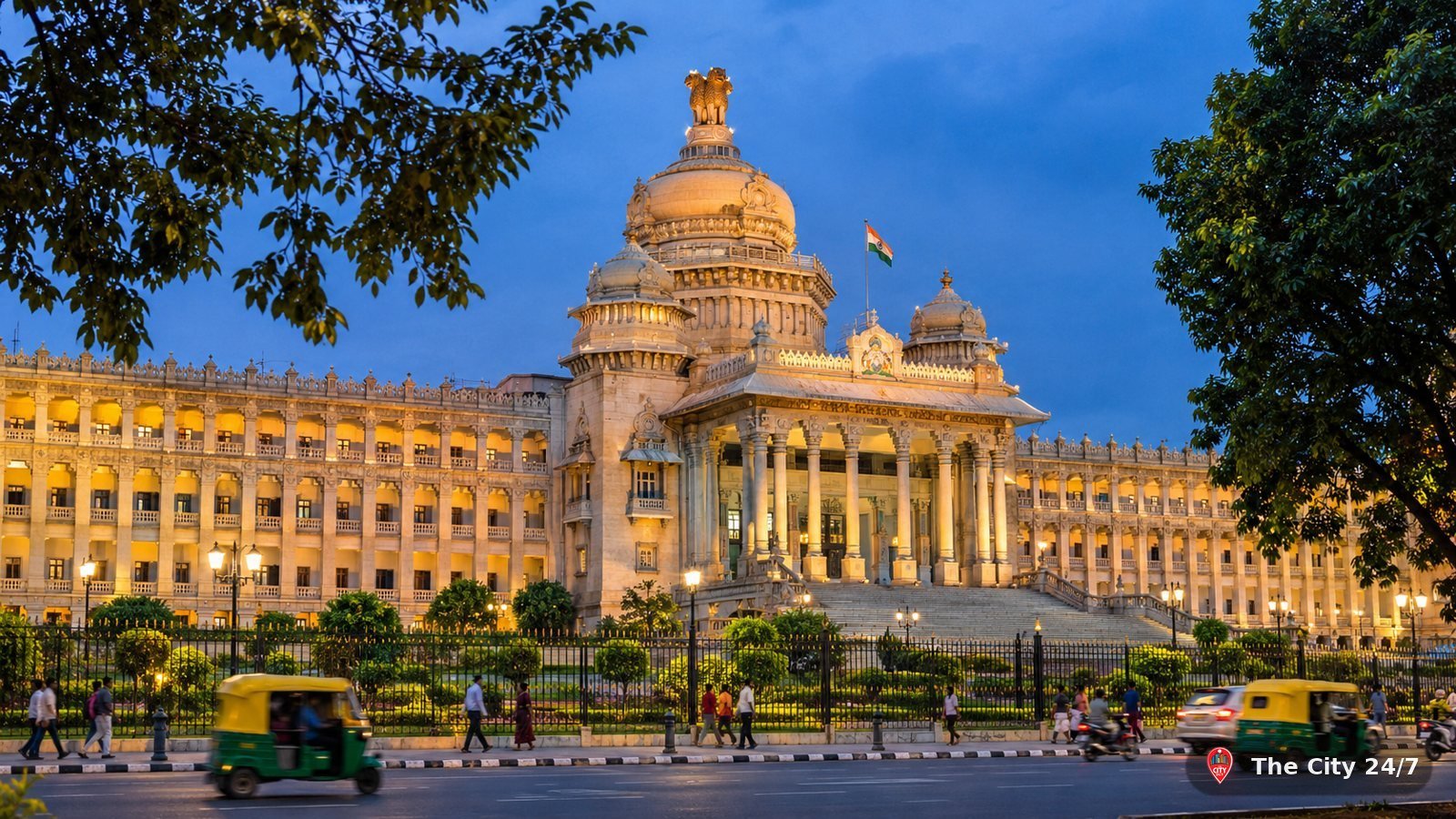
Kengal Hanumanthaiah: The Village Boy Who Gave Bengaluru Vidhana Soudha
November 22, 2026
 PEOPLE OF BANGALORE
Sir K. P. Puttanna Chetty: The Railway Man Who Became Bengaluru's First Elected Municipal President
November 15, 2026
 LITERATURE
Vikram Sampath: Writing History From Bengaluru
September 28, 2026
 SCIENCE
B. P. Radhakrishna: The Bengaluru Man Called the Doyen of Indian Geology
September 25, 2026
 PEOPLE OF BANGALORE
Satish Dhawan: The IISc Professor Who Moved India's Space Programme to Bengaluru
November 8, 2026
 CITY BUILDERS
Kempe Gowda: The Man Who Built Bengaluru From a Mud Fort in 1537
November 1, 2026
