



“Calling it South Indian food is like calling everything between Lisbon and Warsaw European cooking. Bengaluru serves at least seven distinct traditions and most visitors only meet one.”
• On the most flattened cuisine label in India
The dosa and idli that visitors encounter in Bengaluru come from the Udupi tradition, which spread outward from a temple town on the Karnataka coast and now underpins most vegetarian restaurant cooking across India. It is excellent and it is one tradition among many, and this city happens to serve all of them because a century of migration brought each one here.
The seven worth knowing: Udupi, the vegetarian tiffin tradition; Kannada, the wider state cuisine including ragi and jolada rotti; Mangalorean coastal, built on coconut and red chilli; Kodava from Coorg, with pork and vinegar; Andhra, the spiciest; Chettinad from Tamil Nadu, the most complex; and Kerala, with its own coconut and fish repertoire.
This guide covers each with what it is, what to order and where to look. I am naming traditions and areas rather than specific restaurants, because good ones are numerous and change. Our local food and dosa guides cover the Karnataka core in more detail.
Quick Information
Seven traditions, what each does and what a meal costs. Order the unlimited meals at least once.
What Is Udupi Food and Why Is It Everywhere?
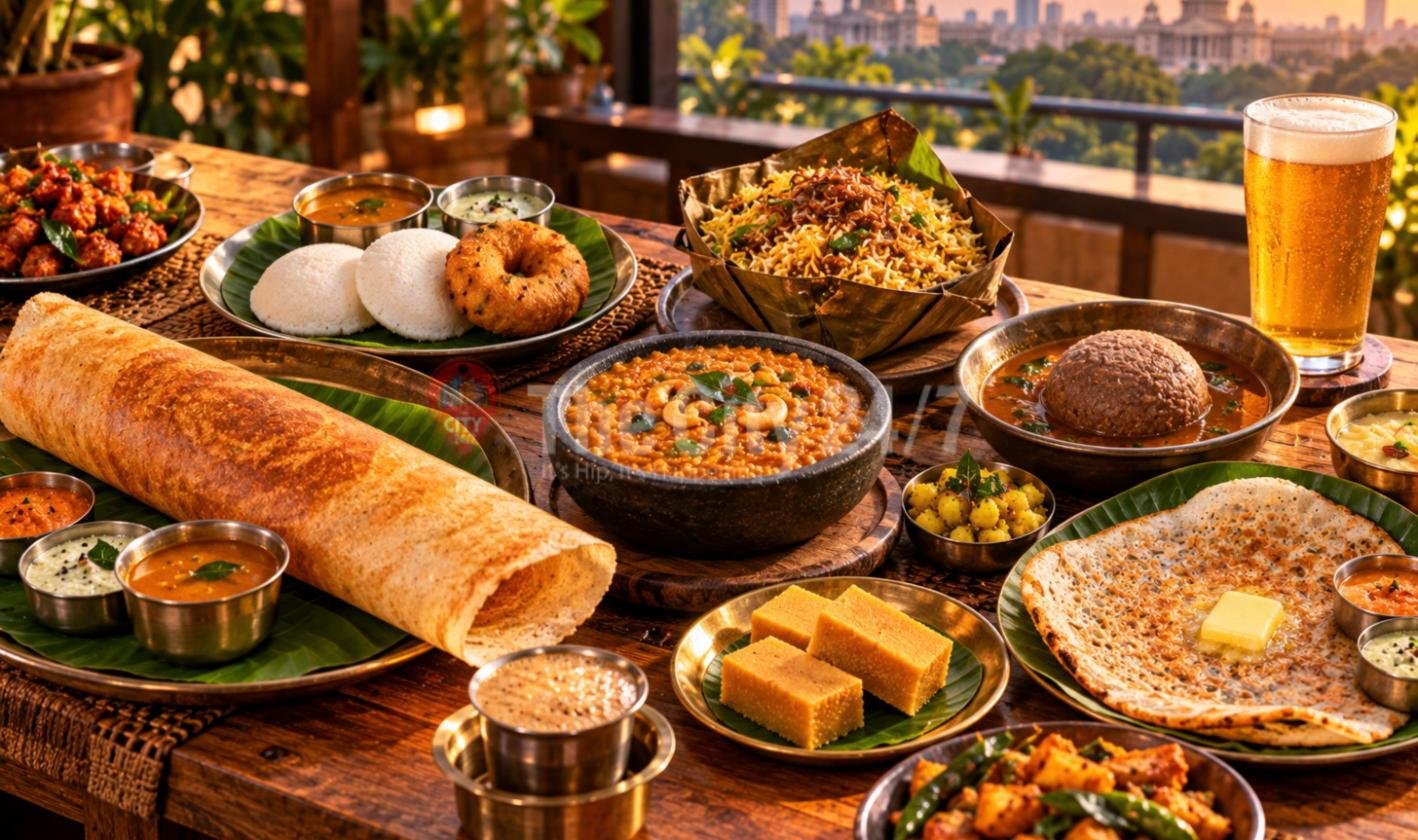
Udupi is a vegetarian temple cooking tradition from coastal Karnataka that spread across India through restaurants, and it is the source of the dosa, idli, vada and sambar most people mean when they say South Indian food.
The tradition is strictly vegetarian, avoids onion and garlic in its most orthodox form, and built a repertoire of fermented batters, rice preparations and coconut chutneys that travels extremely well. Restaurateurs from the Udupi region opened eating houses across India through the twentieth century, which is why you can get a competent dosa in Delhi, Mumbai or Kolkata.
In Bengaluru you get it at its source quality, in darshinis and vegetarian restaurants in every neighbourhood, for forty to two hundred rupees a dish. Order a masala dosa, idli vada, rava idli, khara bath or a plate of set dosa with sagu, and a filter coffee with it. Go between seven and half past ten in the morning or four and half past six in the evening, when turnover is highest and everything is freshly made.
What Is a Meals and Why Should I Order One?
An unlimited thali served at lunch: rice, sambar, rasam, two or three vegetable dishes, curd, papad, pickle and a sweet, for roughly a hundred to two hundred and fifty rupees a head. It is the best value lunch in India.
The meals is how South India eats lunch, and it is a complete, balanced, endlessly refilled meal for the price of a coffee at a specialty cafe. Servers circulate continuously with buckets, and the correct way to decline more is a small flat hand gesture over the plate, which everybody understands and nobody minds.
Regional versions differ substantially. A Karnataka meals is milder with jaggery in the sambar and frequently includes ragi. An Andhra meals is considerably spicier, with gongura, multiple pickles and Guntur chilli heat, and is the one to order if you like heat. A Kerala sadya style meal is served on a banana leaf with a longer sequence of dishes. All three are worth doing, and the Andhra version is the one visitors find most memorable, for reasons they will discover.
“Order an Andhra meals once. You will understand something about chilli that no menu description can convey, and you will not regret it until later.”
• Said with affection and some warning
Where Do I Try Coastal and Coorg Food?
At dedicated Mangalorean, Kerala and Kodava restaurants, which exist in numbers across the city. These traditions are non vegetarian, coconut heavy and completely distinct from the Udupi vegetarian repertoire.
- Mangalorean, from the Karnataka coast. Built on coconut, red chilli and tamarind. Order neer dosa with chicken or fish curry, kori rotti, ghee roast, and Mangalore buns. Rs 300 to 900 a head.
- Kodava, from Coorg. Pandi curry, a pork curry with kachampuli vinegar, plus kadambuttu rice dumplings and noolputtu. Rich, sour and unlike anything else in India. Rs 400 to 1000.
- Kerala. Appam with stew, meen curry, Malabar biryani, beef fry and puttu. Widely available in this city and reliably good, at Rs 250 to 700 a head.
- Chettinad, from Tamil Nadu. The most complexly spiced South Indian tradition, with pepper chicken, kuzhambu, dry roasts and a long list of ground masalas. Rs 300 to 800.
- Andhra. The spiciest, and the best value. Unlimited meals, biryani, gongura dishes and pickles that will recalibrate your tolerance. Rs 150 to 500.
- Military hotels. An old Bengaluru institution: small, no frills, non vegetarian Kannada restaurants serving mutton, liver fry, ragi mudde and rice. Genuinely local, increasingly rare and worth seeking out.
- Look for a named tradition. A restaurant that says Mangalorean, Kodava, Andhra or Chettinad on the sign does that thing properly. A menu offering all of them does none of them well.
How Spicy Is South Indian Food in Bangalore?
It varies enormously by tradition. Udupi and Karnataka cooking is mild and slightly sweet, Kerala is moderate, Mangalorean and Chettinad are hot, and Andhra is genuinely very hot.
The Karnataka end of the range surprises people: sambar here contains jaggery, vegetable dishes are often faintly sweet, and the chilli level is modest. That is correct rather than a compromise, and it is the Udupi influence. If you have eaten South Indian food in a more northern Indian city and found it hot, you were probably eating Andhra or a generic restaurant version.
At the other end, Andhra food uses Guntur chilli and a great deal of it, and an Andhra meals at a dedicated restaurant is a genuine experience. Ask for less spicy when ordering if you need to, which is a normal request everywhere, and use curd rice, buttermilk or plain curd to manage heat rather than water, which does not work. Buttermilk with a heavy lunch is the local solution and it is the correct one.
How Do I Eat South Indian Food Properly?
- Use your right hand. Rice meals, ragi mudde, rotti and dosa are all hand food, and the hand genuinely works better than cutlery for all of them. Nobody will mind if you are clumsy.
- Mix as you go. Pour sambar over a portion of rice, mix it into a mound, eat that, then move on to rasam and curd rice. Do not mix everything at once.
- End with curd rice. The final course of a meals for a reason: it cools the palate and settles the heat. Skipping it is a mistake.
- Decline refills with a gesture. A small flat hand over the plate. Servers understand it instantly and it saves you from an unlimited lunch becoming a problem.
- Eat tiffin at peak hours. 7 to 10.30 AM and 4 to 6.30 PM. Outside those windows you are eating what did not sell.
- Drink filter coffee with tiffin. Not with a heavy meals, where buttermilk or lime soda works better. The coffee belongs with breakfast and evening tiffin.
- Do not ask for a fork apologetically. They will bring one without comment if you want it. This is a city entirely relaxed about how people eat.
South Indian Food in Bangalore: Frequently Asked Questions
What are the main types of South Indian food in Bangalore?
Udupi vegetarian tiffin, the wider Kannada state cuisine, Mangalorean coastal, Kodava from Coorg, Andhra, Chettinad from Tamil Nadu and Kerala. All seven are served properly in this city, and they differ substantially in spice, ingredients and method.
What is Udupi food?
A strictly vegetarian temple cooking tradition from coastal Karnataka that spread across India through restaurants, and the source of the dosa, idli, vada and sambar most people mean by South Indian food. It underpins most of Bengaluru's darshini cooking.
What is a meals in Bangalore?
An unlimited thali served at lunch with rice, sambar, rasam, vegetable dishes, curd, papad, pickle and a sweet, for roughly Rs 100 to 250 a head. Servers refill continuously, and a small flat hand gesture over the plate is how you decline.
Which South Indian food is the spiciest?
Andhra, by a clear margin, using Guntur chilli generously across meals, biryani, gongura dishes and pickles. The rough order from mildest to hottest is Udupi, Kerala, Kannada, Mangalorean, Chettinad, Andhra.
Why does Karnataka food taste slightly sweet?
Because jaggery is traditionally used in sambar and many vegetable dishes, particularly in the Udupi lineage. It is correct rather than an error and it is what distinguishes Karnataka cooking from the spicier Andhra and Tamil traditions.
Where can I eat Mangalorean food in Bangalore?
At dedicated Mangalorean and coastal restaurants, which exist across the city. Order neer dosa with fish or chicken curry, kori rotti, ghee roast and Mangalore buns, at roughly Rs 300 to 900 a head. Look for a restaurant that names the tradition on its sign.
What is Kodava food from Coorg?
The cuisine of the Kodava people of Coorg, built around pandi curry, a pork curry made with kachampuli vinegar, along with kadambuttu rice dumplings and noolputtu. Rich and sour and unlike anything else in India, at Rs 400 to 1000 a head.
What is a military hotel in Bangalore?
An old Bengaluru institution: a small, no frills, non vegetarian Kannada restaurant serving mutton, liver fry, ragi mudde and rice. They are genuinely local, increasingly rare, and among the most interesting eating in the city.
How do I handle very spicy South Indian food?
Use curd rice, plain curd or buttermilk rather than water, which does not work. Asking for less spicy when ordering is completely normal, and ending a meals with curd rice is the traditional way to cool the palate.
What time should I eat South Indian tiffin?
Between seven and half past ten in the morning, or four and half past six in the evening, which are the two peak service windows when everything is freshly made. Meals are served roughly half past twelve to three in the afternoon.
Know a Restaurant Doing One Tradition Properly?
The best South Indian food in Bengaluru comes from restaurants that do exactly one tradition and do it for decades, and those are the hardest to find if you did not grow up nearby. If you know one, click the WhatsApp icon at the bottom right of your screen and tell me which tradition and which street. That is also the fastest way to reach The City 24/7 about anything at all.
And if you want the city explained one useful thing at a time, join our ever growing community. One weekly email, free, and reliably about lunch.
Same city, new stories, always.

Related Stories
 DINING
North Indian Food in Bangalore: Where the Real Thing Is
July 26, 2026
 DINING
International Food in Bangalore: Chinese, Italian, Japanese and Where the Real Thing Is
July 26, 2026
 DINING
Vegetarian in Bangalore: One of the Best Cities in the World for It
July 12, 2026
 DINING
Bangalore's Food Neighbourhoods: What Each One Does Better Than the Rest
July 30, 2026
 DINING
Bangalore's Rooftops: Where to Go, and Why 6.30 PM Matters
July 28, 2026
 DINING
The Ultimate Bangalore Food Guide: What to Eat, Where, and When
July 13, 2026
