


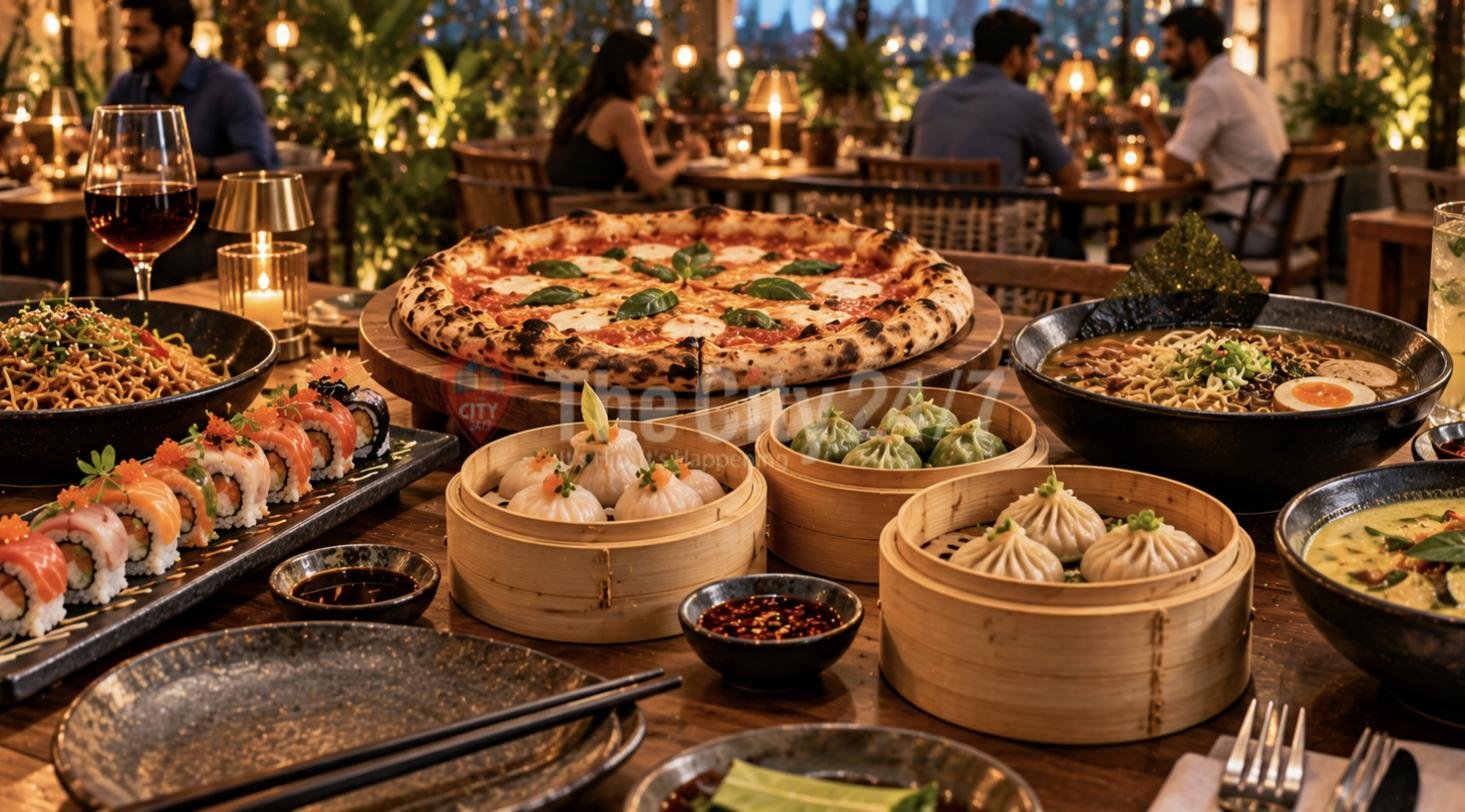
“Bengaluru's international food improved the moment enough people had lived abroad to know when they were being sold something inferior.”
• On the actual mechanism of culinary progress
Bengaluru eats internationally better than most Indian cities and less well than its own residents would like. The reason is demand: a large expatriate population, a very large population of engineers who have worked overseas, and a returning diaspora who know what these cuisines taste like at home. That audience is demanding, and the restaurant market has responded unevenly.
Some cuisines are genuinely well served now. Italian has improved enormously, with real pizza ovens and proper pasta cooking. Japanese is credible at the upper end. Middle Eastern and Lebanese food is good and reasonably priced. Thai and Vietnamese exist in good versions. Korean has grown quickly. Chinese is the most complicated case, because two entirely different things are sold under that name.
This guide covers what to expect from each, how to find the real version, where the clusters are and what to pay. Areas and cuisines rather than specific restaurants, since this is the fastest changing category in the city.
Quick Information
What each cuisine costs and where to look. The Chinese row needs the whole section below it.
What Is the Difference Between Indian Chinese and Chinese Food Here?
They are two separate cuisines. Indian Chinese is a genuine Indian regional cuisine with Chinese roots, cheap and excellent. Regional Chinese cooking, Sichuan, Cantonese and dim sum, is a much smaller and more expensive category.
Indian Chinese, developed by Chinese communities in Kolkata and adapted across India, gives you gobi manchurian, chilli chicken, fried rice, hakka noodles and chilli paneer, at a hundred and fifty to five hundred rupees. It is not an inferior version of Chinese food, it is its own thing, it is delicious, and Bengaluru does it extremely well including at street carts and small counters. Gobi manchurian in particular is close to a local staple.
Actual regional Chinese cooking is a different proposition: proper Sichuan with numbing peppercorn, Cantonese roasts, and dim sum made by someone who knows how. There are good places doing this in the CBD, Indiranagar and the hotel dining rooms at eight hundred to two thousand five hundred rupees a head, and there are far fewer of them. Know which one you are ordering, and do not be disappointed by an Indian Chinese restaurant for failing to be something it never claimed to be.
Is Italian Food in Bangalore Any Good?
Yes, and it has improved more than any other international cuisine here in the last decade. Real wood or electric deck ovens, proper dough fermentation, and pasta cooked correctly are now available in numbers.
- Look for the oven. A visible wood fired or high temperature deck oven is the single best indicator. Pizza from a standard commercial oven is a different and lesser product.
- Ask about the dough. A pizzeria that talks about fermentation time, flour type and hydration is a pizzeria that cares. This is now a normal conversation in Indiranagar.
- Order a simple pasta to test. Cacio e pepe, aglio e olio or a carbonara. Four ingredients and nowhere to hide. If it arrives with cream in the carbonara, you have learned something.
- Where to look. Indiranagar has the highest concentration, with Koramangala, the CBD, HSR and Whitefield all holding good options. The hotel dining rooms do the formal version well.
- Expect Rs 700 to 2500 a head. With the pizzerias at the lower end and the hotel and fine dining Italian at the upper end.
- Note the vegetarian strength. Italian food happens to suit this city's large vegetarian population extremely well, which is part of why it has grown so fast here.
“One kitchen cannot do Italian, Thai, Chinese and Mexican. It can do one of them and reheat the others, and you will be able to tell which.”
• The rule that governs this entire category
Where Do I Find Good Japanese, Korean and Southeast Asian Food?
Japanese is credible at the upper end in the CBD, Indiranagar and the hotels. Korean has grown quickly across the newer belts. Thai and Vietnamese have good dedicated places, mostly in Indiranagar, Koramangala and Whitefield.
Japanese in Bengaluru works at price. Sushi at twelve hundred to four thousand rupees a head at a serious restaurant with proper sourcing is genuinely good, and ramen and izakaya style places have grown substantially and are better value. Below a certain price point the sourcing simply does not work for raw fish in an inland city, which is worth knowing before ordering cheap sushi anywhere.
Korean is the fastest growing category, driven partly by a Korean expatriate community and partly by broader cultural interest, with barbecue and stew restaurants at eight hundred to two thousand rupees a head. Thai and Vietnamese both have genuinely good dedicated restaurants, and the test for Thai is whether the curry pastes taste made rather than bought. The general rule across all of these: a restaurant cooking one Asian cuisine beats a pan Asian menu every time.
What International Food Is Best Value in Bangalore?
Middle Eastern and Lebanese food, and Indian Chinese. Both are excellent, both are widely available and both cost a fraction of the European and Japanese options.
Shawarma, mezze, hummus, falafel and charcoal grills are done well across the city, particularly in the Cantonment around Frazer Town and Shivajinagar where there is a long Middle Eastern influenced tradition, and in the newer belts. Expect two hundred and fifty to twelve hundred rupees a head, and the street level shawarma shops in particular are some of the best cheap food in Bengaluru.
Beyond those two, the honest picture: Mexican and Latin American food here is improving but still uneven, European and Continental food is best in the CBD hotel dining rooms rather than in standalone restaurants, and anything requiring specific imported perishables will cost more here than it should for reasons of supply rather than ambition. The cuisines that thrive in Bengaluru are the ones whose core ingredients are either local or shelf stable.
How Do I Pick an International Restaurant Here?
- One cuisine per restaurant. The single most reliable filter in this category. A pan Asian or multi cuisine menu is a kitchen doing one thing and reheating three.
- Check who is in the kitchen. A chef from that cuisine, or one who trained in it seriously, changes the food. Good restaurants here advertise this because it works.
- Look at the menu length. Short is confident. A twelve page international menu means frozen components and a microwave.
- Order the test dish. A simple pasta, a plain pizza margherita, tamago or a simple nigiri, a green curry, a plate of hummus. The dishes with nowhere to hide.
- Check the room's clientele. A Korean restaurant full of Korean diners, a Japanese place with Japanese regulars. The most reliable signal available anywhere in the world.
- Be careful with cheap sushi. Bengaluru is inland. Serious raw fish requires serious sourcing, which costs money, and the cheap version is not a bargain.
- Book weekends. Friday and Saturday between eight and half past ten, the good international restaurants in Indiranagar and the CBD are full. Midweek you can walk in.
International Food in Bangalore: Frequently Asked Questions
What is the difference between Indian Chinese and Chinese food?
They are separate cuisines. Indian Chinese, developed by Chinese communities in Kolkata and adapted across India, gives you gobi manchurian, chilli chicken and hakka noodles at Rs 150 to 500 and is excellent on its own terms. Regional Chinese cooking such as Sichuan, Cantonese and dim sum is a smaller, more expensive category at Rs 800 to 2500 a head.
Is Italian food good in Bangalore?
Yes, and it has improved more than any other international cuisine here in the last decade, with real wood fired and high temperature deck ovens, proper dough fermentation and correctly cooked pasta. Indiranagar has the highest concentration, at roughly Rs 700 to 2500 a head.
Where can I get good Japanese food in Bangalore?
In the CBD, Indiranagar and the hotel dining rooms, at roughly Rs 1200 to 4000 a head for serious sushi with proper sourcing. Ramen and izakaya style places have grown substantially and offer better value. Be cautious with cheap sushi in an inland city.
What is the best value international food in Bangalore?
Middle Eastern and Lebanese food at Rs 250 to 1200 a head, particularly the street level shawarma shops, and Indian Chinese at Rs 150 to 500. Both are excellent and cost a fraction of the European and Japanese options.
How do I find an authentic international restaurant in Bangalore?
Choose restaurants that cook one cuisine rather than a pan Asian or multi cuisine menu, check whether the kitchen has a chef from that tradition, favour short menus, and look at whether the dining room contains people from that country.
Is there Korean food in Bangalore?
Yes, and it is the fastest growing international category, with barbecue and stew restaurants at roughly Rs 800 to 2000 a head, driven by a Korean expatriate community and broader cultural interest. Most are in Indiranagar, Koramangala, HSR and Whitefield.
Which areas of Bangalore have the best international restaurants?
Indiranagar has the widest range, followed by the central business district for hotel dining rooms and formal European food, Koramangala and HSR for newer independent places, and Whitefield and the ORR belt for the eastern expatriate and technology population.
Why is some international food in Bangalore expensive?
Because cuisines requiring specific imported perishables face real supply costs in an inland city. The international cuisines that thrive here are the ones whose core ingredients are either locally available or shelf stable, which is why Italian and Middle Eastern food does better than, say, seafood led European cooking.
What should I order to test an international kitchen?
The dish with nowhere to hide: a simple pasta like cacio e pepe or aglio e olio, a plain pizza margherita, tamago or simple nigiri at a Japanese restaurant, a green curry for Thai, or a plate of hummus for Middle Eastern.
Do I need to book international restaurants in Bangalore?
On Friday and Saturday between eight and half past ten, yes, particularly in Indiranagar and the CBD. Midweek you can generally walk in, which is another reason to eat out Tuesday to Thursday in this city.
Found the Real Thing?
International food is the fastest changing category in Bengaluru, and a restaurant that was excellent last year may have changed chefs since. If you have found somewhere cooking one cuisine properly, click the WhatsApp icon at the bottom right of your screen and tell me. Recommendations from people who know what the dish should taste like at home are particularly welcome. That is also the fastest way to reach The City 24/7 about anything at all.
And if you want the city explained one useful thing at a time, join our ever growing community. One weekly email, free.
Same city, new stories, always.

Related Stories
 DINING
North Indian Food in Bangalore: Where the Real Thing Is
July 26, 2026
 DINING
South Indian Food in Bangalore: Seven Traditions and Where to Eat Each
July 26, 2026
 DINING
Vegetarian in Bangalore: One of the Best Cities in the World for It
July 12, 2026
 DINING
Bologna, Indiranagar: The Italian Restaurant That Makes Its Own Ricotta
September 17, 2026
 DINING
Bangalore's Food Neighbourhoods: What Each One Does Better Than the Rest
July 30, 2026
 DINING
Booking a Restaurant for an Occasion in Bangalore: Birthdays, Family and Celebrations
July 28, 2026
