



“Your CA is the only person in your startup who gets paid to say no to you. Pick one who actually does.”
• Tariq Sallam
Every founder in Bengaluru has the same origin story with accounts. Year one, you do it yourself on a spreadsheet called final_final_v3. Year two, a friend's cousin who is "almost a CA" files your GST from his phone. Year three, a notice arrives, a bank asks for audited financials before a loan, or an investor's lawyer asks for your ROC filings, and suddenly everybody is very interested in who your chartered accountant is.
I have been on the wrong end of bad paperwork myself, so I am slightly evangelical about this. A good CA is not a cost centre. A good CA is the reason you never pay a late fee, never panic about a tax notice, and can hand an investor a clean set of books on a Tuesday afternoon.
So this is the guide I wish someone had handed me: what a chartered accountant actually does for a startup or small business, what the work commonly costs in Bengaluru in 2026, which deadlines matter right now (one of them is this weekend), and how to tell a good firm from one that will cost you money later.
Quick Information
A CA costs less per month than your team's coffee order. Missing one ROC form costs Rs 100 a day, every day, until someone notices.
Do I Actually Need a Chartered Accountant for My Startup?
If you run a private limited company, yes, from the day you incorporate. Under the Companies Act, every company must have its annual accounts audited by a practising chartered accountant, whatever its turnover, and the board has to appoint the first auditor within 30 days of incorporation. There is no "we are too small" exemption for companies.
Sole proprietors and partnerships have more breathing room. You need a CA for a tax audit once your turnover crosses the income tax audit limit (more on that below), and in practice you will want one for GST, TDS and loan paperwork long before that. LLPs need an audit once turnover crosses Rs 40 lakh or contributions cross Rs 25 lakh.
You can legally file your own GST returns. You cannot legally sign your own company's audit report. Everything else is a question of how much your time is worth and how much risk you enjoy.
What Does a CA Actually Do for a Small Business?
A CA for a small business usually does four jobs: keeps the books, files the recurring tax returns, handles the yearly company law filings, and audits or certifies what the law or a bank needs signed. Some firms do all four; many split bookkeeping off to a junior team or a separate accounting partner.
- Bookkeeping: recording sales, expenses and bank entries every month, reconciling bank statements, and producing a profit and loss account you can actually read.
- GST: GSTR-1 (sales) and GSTR-3B (summary and payment) every month or quarter, input tax credit matching, and the annual GSTR-9 where it applies.
- TDS and payroll: deducting tax on salaries, rent and vendor payments, quarterly TDS returns, Form 16s, plus Karnataka professional tax for your employees.
- ROC compliance: board meeting minutes, the AGM, AOC-4 (financial statements) and MGT-7 or MGT-7A (annual return), auditor appointment (ADT-1) and director KYC.
- Income tax: the company's ITR, advance tax estimates, and the tax audit report if you cross the limit.
- Advisory: structuring founder salaries, ESOPs, startup tax benefits, valuation reports for fundraising, and replying to notices before they become problems.
How Much Does a Chartered Accountant Charge in Bangalore?
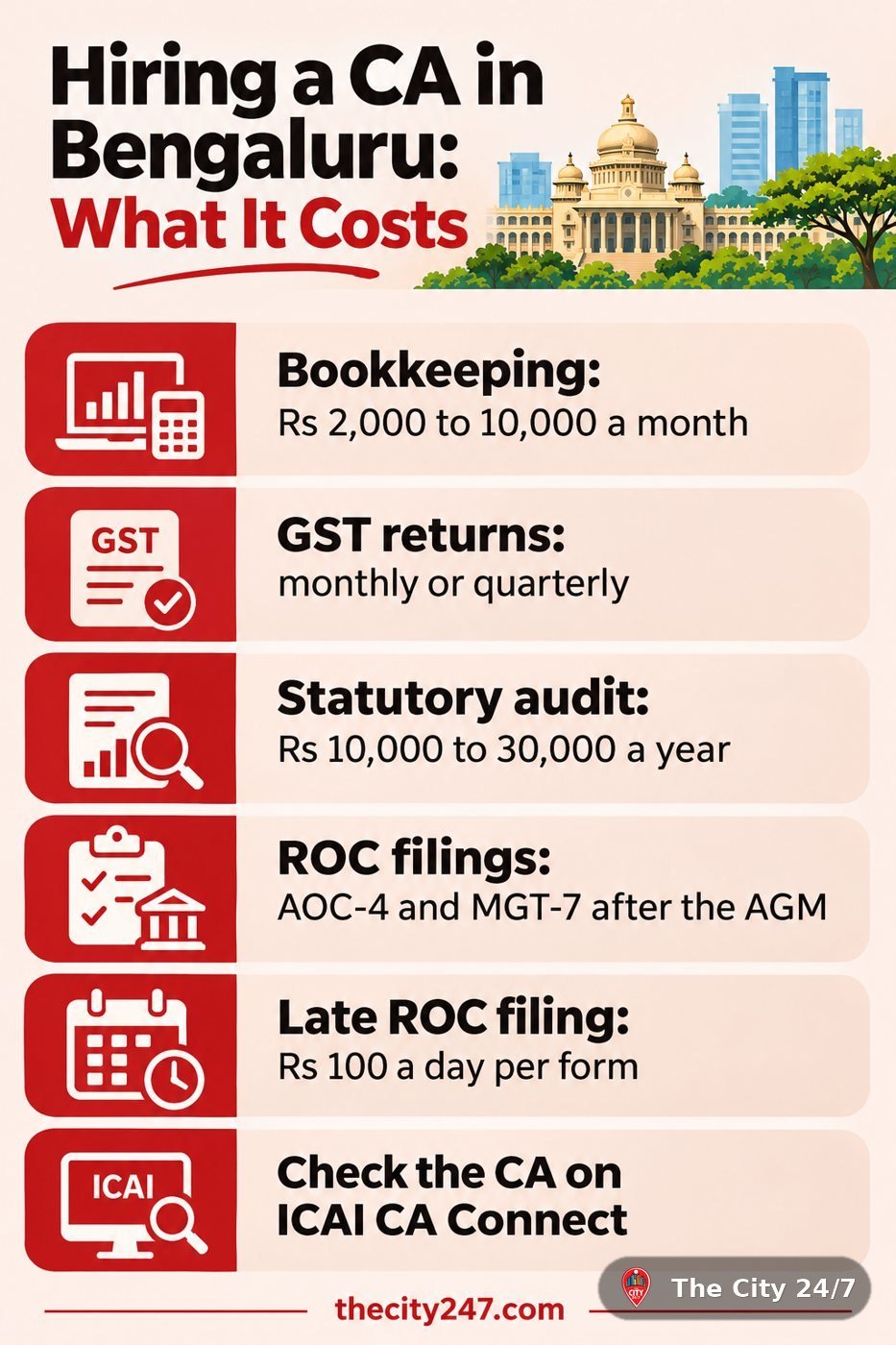
There is no official fee schedule, so prices vary a lot, but the ranges most commonly quoted in Bengaluru in 2026 are: bookkeeping Rs 2,000 to 10,000 a month, a statutory audit for a small company Rs 10,000 to 30,000 a year, and ROC annual filing Rs 5,000 to 15,000 a year. Treat these as starting points for a conversation, not a menu.
What drives the price up or down?
- Transaction volume: the single biggest factor. Thirty invoices a month and three hundred invoices a month are different jobs, even at the same revenue.
- Clean inputs: if you hand over a tidy bank feed and invoice folder, you pay less. If your CA has to chase you for receipts on WhatsApp, you pay for that too, one way or another.
- Scope: payroll, MIS reports, investor reporting, foreign remittances and ESOP accounting are all add-ons.
- Firm size and location: a solo practitioner in Jayanagar or Malleshwaram will usually quote less than a mid-size firm on Outer Ring Road with a partner on every call.
- Urgency: "Can you file this today?" in the last week of a deadline month is the most expensive sentence in Indian accounting.
What does a full year cost for a small private limited company?
Add it all up (bookkeeping, GST, TDS, ROC filings, audit, ITR and director KYC) and a small, early-stage private limited company typically lands somewhere between about Rs 60,000 and Rs 2.3 lakh a year. A pre-revenue company with a handful of transactions sits near the bottom; a funded startup with payroll and monthly investor reports sits near the top or above it.
Which Deadlines Should My CA Be Tracking Right Now?
The deadline most Bengaluru companies are racing this week is MGT-7 or MGT-7A, the annual return, which is due within 60 days of the AGM. If your AGM was on 30 September 2026, that lands on 29 November 2026. AOC-4, the financial statements form, was due within 30 days of the AGM, so for most companies it fell at the end of October.
- Every month: GSTR-1 by the 11th and GSTR-3B by the 20th for monthly filers (quarterly filers under the QRMP scheme follow a different calendar); TDS deposit by the 7th.
- Every quarter: TDS returns (31 July, 31 October, 31 January and 31 May) and advance tax instalments.
- Every year: AGM by 30 September, AOC-4 within 30 days of it, MGT-7 or MGT-7A within 60 days, director KYC (DIR-3 KYC) by 30 September, and GSTR-9 by 31 December where applicable.
- Once: first auditor appointed within 30 days of incorporation, and the commencement of business declaration within 180 days.
ROC forms filed late attract an additional fee of Rs 100 per day per form, with no cap. Miss both AOC-4 and MGT-7 by six months and you are looking at roughly Rs 36,000 in late fees, which is more than many small companies pay their CA in a year. A missed director KYC costs Rs 5,000 per director.
When Does My Business Need a Tax Audit?
A business needs an income tax audit once its turnover crosses Rs 1 crore in a year, or Rs 10 crore if cash receipts and cash payments are each no more than 5% of the total. For professionals such as consultants, designers and doctors, the limit is Rs 50 lakh of gross receipts, or Rs 75 lakh if cash is within that same 5%.
Miss it and the penalty is 0.5% of turnover, up to Rs 1.5 lakh. Your CA should flag it months in advance, not in the week the audit report is due.
The Income-tax Act, 2025 replaced the 1961 Act from 1 April 2026 and introduces the idea of a single "tax year". The thresholds above are broadly carried over, but section numbers and some forms are changing. A good CA should already be explaining what changes for you. If yours looks blank when you mention it, that is useful information.
Should I Hire a Solo CA, a Mid-Size Firm or an Online Compliance Platform?
For most early-stage Bengaluru startups, a solo practitioner or a small firm with a dedicated bookkeeper is the sweet spot; online compliance platforms suit very simple, low-volume companies; and mid-size or large firms make sense once you have investors, foreign money or a board that asks hard questions.
- Solo CA or small local firm: cheapest, personal, often brilliant on tax and notices. The risk is capacity: one person, many clients, and every deadline falls on the same day for all of them.
- Online compliance platforms: fixed packages, tidy dashboards and reminders, good for incorporations and simple filings. Ask who actually signs your audit and whether you get a named person or a ticket number.
- Mid-size firms: a team, a manager and a partner, proper processes, startup-specific experience (ESOPs, valuations, FEMA filings for foreign investment). Costs more, worth it once money from outside India comes in.
- Large and Big Four firms: for later-stage companies with serious audit, transfer pricing or due diligence needs. If you are reading this guide, probably not yet.
How Do I Check That a CA Is Genuine?
Ask for their ICAI membership number and confirm they hold a Certificate of Practice, then look them up on ICAI's CA Connect portal at caconnect.icai.org, where you can search practising CAs and firms by city and area of service. Only members with a Certificate of Practice can sign audit reports.
Second check: every certificate, audit report or attestation a CA signs must carry a UDIN (Unique Document Identification Number). You can verify it yourself at udin.icai.org. A net worth certificate for a visa or a turnover certificate for a tender without a valid UDIN is a piece of paper, not a certificate.
What Should I Ask Before I Hire a CA Firm?
Ask for a written engagement letter that lists every deliverable, every due date and every fee, and ask who exactly will do your work. Then ask the questions below and listen to how they answer, not just what they say.
- Who is my day-to-day person? You want a name and a phone number, not "our team will reach out".
- What is included, and what is extra? Notice replies, payroll, MIS reports and revised returns are the usual surprise invoices.
- How will I know a filing is done? A good firm sends acknowledgements and a monthly compliance summary without being asked.
- Which software do you use? Make sure you get access to your own books, and that they can be exported if you ever leave.
- Have you worked with companies like mine? A firm that does five SaaS startups will handle your foreign customer invoices and export of services better than one that does mostly jewellers in Chickpet, and vice versa.
- What happens if you miss a deadline? The best answer is a calm process. The worst answer is a laugh.
What Are the Red Flags When Choosing an Accountant?
The biggest red flags are a verbal-only scope, a fee that seems too good to be true, and a CA who asks for your passwords to everything but never sends you anything back. If your bank reconciliation has not been done in months, your books are fiction, however neat they look.
- No engagement letter: everything is "we'll manage, sir" until it is not.
- Your GST portal and income tax logins live only with them, and they change the passwords.
- Promises of "zero tax" or creative ways to show expenses. That is their creativity and your notice.
- No UDIN on certificates they sign for you.
- They only call you in the last three days of every deadline month.
- They cannot explain your own profit and loss account to you in plain words.
How Do I Find a Good CA Firm in Bangalore?
The fastest way is a shortlist of three from people you trust (other founders, your coworking space, your bank relationship manager), then a check on CA Connect and a 30-minute call with each. Compare written proposals on the same scope, not on the lowest number.
Bengaluru has CA practices in every neighbourhood: older family practices cluster around Jayanagar, Basavanagudi, Malleshwaram and Rajajinagar, while startup-focused firms tend to sit in Koramangala, HSR Layout, Indiranagar and along Outer Ring Road. Location matters less than it used to, since most work is online, but an office you can visit when a notice arrives is reassuring.
“Cheap bookkeeping is the most expensive thing a startup buys. You just get the invoice two years later.”
• Tariq Sallam
Chartered Accountants in Bangalore: Frequently Asked Questions
How much does a CA charge for a private limited company in Bangalore?
Commonly quoted ranges in 2026 are Rs 2,000 to 10,000 a month for bookkeeping, Rs 10,000 to 30,000 a year for a small company's statutory audit and Rs 5,000 to 15,000 a year for ROC filings. A small private limited company typically spends about Rs 60,000 to Rs 2.3 lakh a year in total.
Is a statutory audit compulsory for a private limited company with no turnover?
Yes. Every company registered under the Companies Act must have its accounts audited by a practising chartered accountant every year, even with zero revenue.
What is the due date for MGT-7 in 2026?
MGT-7 or MGT-7A is due within 60 days of the AGM. For a company that held its AGM on 30 September 2026, the due date is 29 November 2026.
What is the penalty for late ROC filing?
An additional fee of Rs 100 per day per form, with no upper cap, on top of the normal filing fee.
How do I verify a chartered accountant in India?
Ask for their ICAI membership number, confirm they hold a Certificate of Practice, and search them on ICAI's CA Connect portal (caconnect.icai.org). Verify the UDIN on any certificate they sign at udin.icai.org.
What is the income tax audit limit for a business?
Rs 1 crore of turnover, or Rs 10 crore if cash receipts and payments are each within 5% of the total. For professionals it is Rs 50 lakh, or Rs 75 lakh with the same cash condition.
Can I file GST returns myself instead of paying a CA?
Yes, the GST portal lets any taxpayer file their own returns. Most businesses still use a CA or accountant because input tax credit matching and corrections take time and mistakes attract interest and late fees.
Should a startup use an online compliance platform or a local CA?
An online platform suits a simple, low-volume company that mostly needs filings done on time. A local CA or small firm is usually better once you have payroll, investors, foreign transactions or tax notices to deal with.
Contact Details
These are the official places to verify a CA or check a filing yourself. Bookmark them before you need them.
Running a Startup or Small Business in Bengaluru?
Fix your bookkeeping this month, put every deadline in one calendar and get your engagement letter in writing. Future you will send present you a thank-you note.
Are you a CA firm, accountant or compliance service that should be in our Business Directory? Or a founder with a question? Reach The City 24/7 through the WhatsApp icon at the bottom right of this page. And for every new Bengaluru guide in your inbox each Friday, join our newsletter at thecity247.com/newsletter.
This guide is general information, not tax or legal advice: thresholds and due dates change, so confirm the details for your business with your own CA. Same city, new stories, always.

Related Stories
 BUSINESS
Accountants, Recruiters, Consultants and Printers in Bangalore: What to Pay and How to Choose
July 31, 2026
 BUSINESS
How to Register a Business in Bangalore: Every Step, Cost and Licence
July 27, 2026
 BUSINESS
Meeting Rooms and Conference Venues in Bangalore: What to Book and What It Costs
July 26, 2026
 BUSINESS
The Best Cafes for Working in Bangalore, and When to Stop Using Them
July 25, 2026
 BUSINESS
Bangalore for Entrepreneurs: The Networks, Resources and Real Costs
July 31, 2026
 BUSINESS
Bangalore's IT and Technology Ecosystem: How It Works and Why It Is Here
July 30, 2026
