


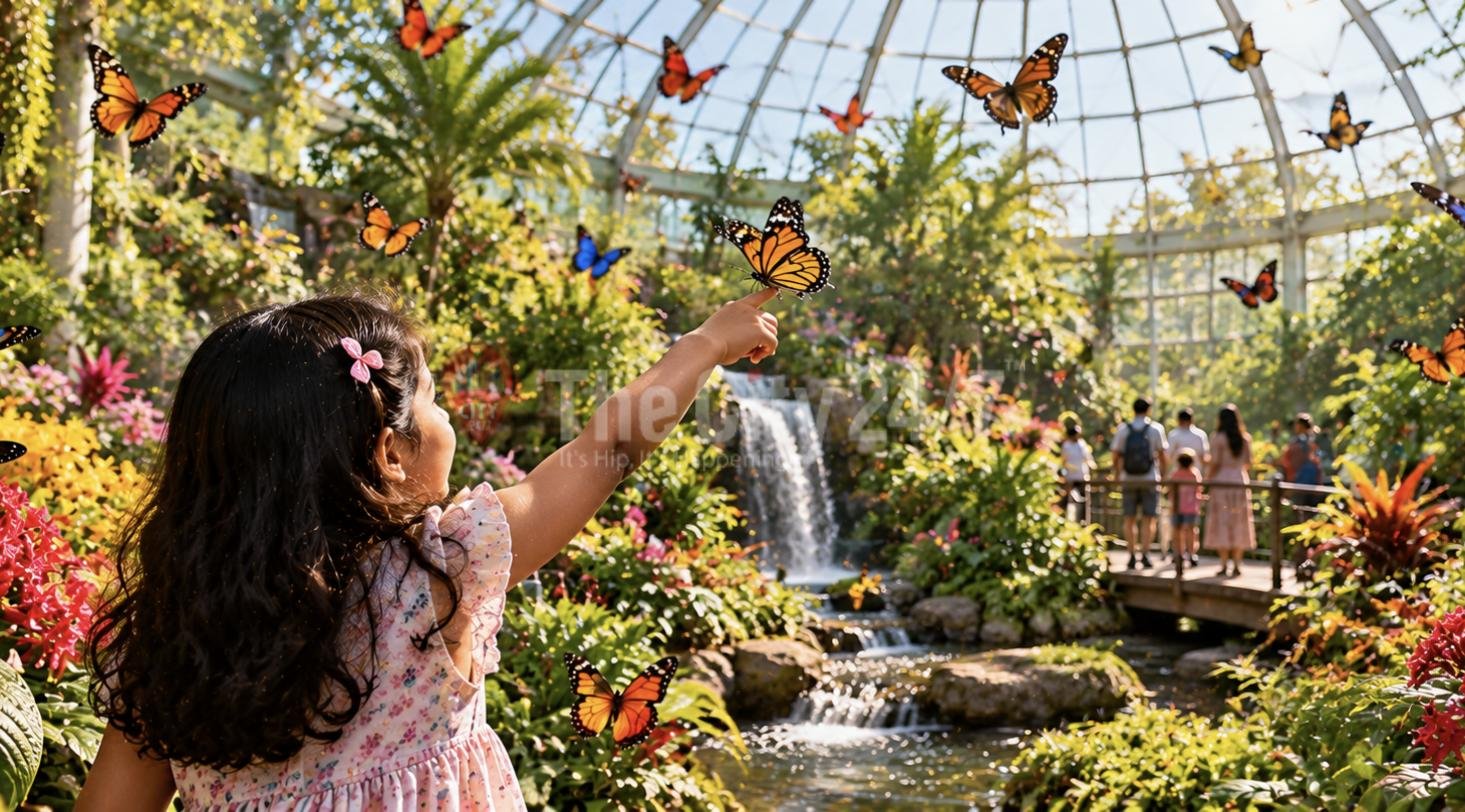
“It takes about twenty minutes to walk through and roughly two of those to realise you have stopped talking. Butterflies do that to people, which is presumably the point.”
• On the conservatory dome
Bannerghatta Butterfly Park is a butterfly conservatory on the Bannerghatta Biological Park campus, about 22 to 25 km south of central Bengaluru, opened in 2006 as India's first park of its kind. It centres on a large glass-domed conservatory where butterflies fly free among host and nectar plants, with an attached museum and research and breeding facilities.
It is open along with the rest of the Bannerghatta campus, generally from around 9.30 AM to 5 PM and closed on Tuesdays, with a separate or combined ticket depending on the current arrangement. The park sits within the same complex as the zoo, the grand safari and the rescue centre, so almost nobody comes here on its own.
That is both the strength and the problem. Families arrive exhausted after three hours of safari and give the butterflies ten minutes. Do it the other way round, and this becomes one of the better hours available with children anywhere near this city.
Quick Information
Everything worth knowing before you drive 25 km to look at insects. Excellent insects, in fairness.
What Exactly Is the Bannerghatta Butterfly Park?
It is a conservation and education facility built around a walk-through conservatory dome, where butterflies live and breed among deliberately chosen plants, backed by a museum and a research and breeding wing. It opened in 2006 and is generally credited as India's first butterfly park.
- The conservatory. A large domed enclosure, humid and planted with host and nectar species, in which butterflies fly free around visitors rather than sitting in cases.
- Host plants matter. The planting is chosen so that butterflies can complete their life cycle inside, which is why you may see eggs, caterpillars and pupae as well as adults.
- The museum. Preserved specimens, life-cycle exhibits and displays on butterfly ecology and identification. Small but genuinely informative.
- Research and breeding. There is a breeding and research component, which is what separates this from a garden with nets over it.
- Conservation purpose. The park exists to study and popularise butterfly conservation, and it sits within a larger biological park with the same remit.
- Scale. Set expectations correctly. This is an hour, not a half day. It is a very good hour.
“A butterfly park is a peculiar test of a visitor. Walk through it fast and you will see almost nothing. Stand still for four minutes and the place fills up around you.”
• On how to visit
What Are Bannerghatta Butterfly Park Timings and Ticket Prices?
The park is generally open from around 9.30 AM to 5 PM and closed on Tuesdays, in line with the rest of the Bannerghatta Biological Park campus, with a modest entry fee that is sometimes sold as part of a combined zoo and safari ticket. Confirm timings and the current ticket structure before you travel, because campus arrangements change.
- Opening hours. Usually around 9.30 AM to 5 PM, with ticket counters closing earlier than the gates.
- Closed Tuesdays. The whole campus is shut. This catches out a remarkable number of people every week.
- Entry fee. Low, in the range of a modest per-person charge, with concessions for children. Camera charges may apply.
- Combined tickets. Zoo, safari and butterfly park are often available together. Buying combined is usually cheaper and saves queueing twice.
- Online booking. Book on the Bannerghatta Biological Park site where available, especially on weekends and holidays.
- Peak crowds. Weekends, school holidays and long weekends are busy from mid-morning. Weekday mornings are transformative by comparison.
Do the butterfly park first, not last. It is quiet, slow and rewards patience, all of which you will have at 10 AM and none of which you will have after three hours of safari queues with tired children.
What Is the Best Season to Visit the Butterfly Park?
The months just after the monsoon, roughly September to November, when butterfly activity and numbers are at their highest, and late morning is the best window on any given day. The dome operates year round, but what you see in October and what you see in April are meaningfully different.
- September to November. Post-monsoon is peak butterfly season across this region. Best numbers, best variety.
- December to February. Cool and pleasant for visitors, with decent activity, especially in the warmer part of the day.
- March to May. Hot. Butterflies are active but the drive and the campus are less pleasant. Go early.
- June to August. Monsoon. The dome is fine but the rest of the campus and the road are wetter and messier.
- Time of day. Roughly 10 AM to noon is when butterflies are most active. Very early and late afternoon are quieter.
- Weather on the day. Butterflies respond to sunlight. A bright morning after rain is the ideal combination.
Is the Butterfly Park Worth It With Children?
Yes, and it is one of the few wildlife experiences near Bengaluru where children see live animals up close without glass or distance between them. The dome is walkable for small legs, the visit is short enough to hold attention, and the life-cycle displays make the biology concrete in a way a textbook does not.
- Age range. Works from around three upwards. Older children get more from the museum and the life-cycle exhibits.
- No barriers. Butterflies land on people. For a child, this is the entire trip justified in one moment.
- The rules. No touching, no catching, no running, stay on the path. Explain this before you go in, not inside.
- Short enough. Forty-five minutes suits a young attention span, which the safari genuinely does not.
- School groups. The park handles school visits and the museum is pitched well for them. Weekday mornings fill with groups, so expect company.
- Combine carefully. Butterfly park, then zoo or safari, then home. In that order, with food in between.
How Do You Photograph Butterflies Without Annoying Everyone?
Stand still near a nectar plant and wait rather than chasing, use natural light, and keep off the planting. The dome is humid and bright and a phone camera will do far better than you expect if you let a butterfly settle instead of pursuing one around a conservatory.
- Wait, do not chase. Pick a flowering plant, stay still, and butterflies will come to you within a few minutes.
- Light. Natural light only. Flash is both unnecessary and unkind to the residents.
- Phones work. Modern phone cameras handle this well. A macro mode helps considerably.
- For a proper camera. A short macro or a 70 to 200 does the job. Expect humidity on the lens when you enter.
- Stay on the path. The planting is the habitat. Stepping into it to get a shot defeats the purpose of the place.
- Camera fees. The campus may charge for cameras. Check at the counter rather than at the gate.
How Do You Get to Bannerghatta Butterfly Park?
Drive or take a cab down Bannerghatta Road, roughly 22 to 25 km from central Bengaluru and typically an hour to ninety minutes depending on traffic, or take a BMTC bus towards Bannerghatta. There is no metro station at the park. The nearest useful metro is on the Green Line towards the south, from where you would continue by road.
- Car or cab. The practical choice. Bannerghatta Road all the way, with parking on the campus.
- Leave early. Out of the city by 8.30 AM and you will be at the gates when they open, ahead of the crowds and with active butterflies.
- BMTC. Buses run towards Bannerghatta from the city. Slower, but cheap and viable on a weekday.
- Metro plus road. Green Line south, then auto or cab. Saves some traffic but not much time.
- Traffic reality. Bannerghatta Road is heavily built up now. Weekend late mornings are the worst combination.
- On campus. The butterfly park is one part of a large site. Check the campus map at the entrance and plan the order of your visit.
FAQs
What are Bannerghatta Butterfly Park timings?
Generally around 9.30 AM to 5 PM, in line with the rest of the Bannerghatta Biological Park campus, with ticket counters closing earlier than the gates. The park is closed on Tuesdays. Confirm current timings on the official site before travelling, since campus arrangements change.
How much is the ticket for Bannerghatta Butterfly Park?
A modest entry fee with concessions for children, and it is often available bundled with zoo and safari tickets, which works out cheaper and saves queueing twice. Camera charges may apply separately. Book online where available, particularly for weekends.
Is Bannerghatta Butterfly Park closed on any day?
Yes, Tuesdays, along with the whole Bannerghatta Biological Park campus. This catches out a lot of visitors, so check the day before you plan a trip.
What is the best time to visit the butterfly park?
Late morning, roughly 10 AM to noon, when butterflies are most active, and ideally between September and November when post-monsoon numbers peak. A bright morning after rain is the best possible combination.
How long does it take to see the butterfly park?
Forty-five minutes to an hour covers the conservatory dome and the museum properly. It is a short visit by design, which is why it works best as the first stop of a Bannerghatta day rather than the last.
Was Bannerghatta the first butterfly park in India?
It opened in 2006 and is generally described as India's first butterfly park, built as a conservation and education facility with a walk-through conservatory, a museum and a research and breeding wing.
Can you visit the butterfly park without the zoo and safari?
Yes, the butterfly park has its own entry, although most visitors combine it with the zoo and safari because they are on the same campus. If you only want the butterflies, a weekday morning visit is quick and quiet.
Is the butterfly park good for children?
Very. The butterflies fly free and often land on visitors, the dome is short and easy to walk, and the life-cycle displays in the museum make the biology tangible. Explain the no touching and no running rules before you go in.
Contact Details
For timings, tickets and campus information. Always confirm before travelling, because ticketing and safari arrangements on the Bannerghatta campus are revised periodically.
Seen Something Good in the Dome?
If you photograph butterflies here, or you know which weeks bring the best numbers into the conservatory, click the WhatsApp icon at the bottom right of your screen and tell me. A seasonal guide to this dome would be genuinely useful and I would rather build it from people who go often. That is also the easiest way to reach The City 24/7 about anything at all.
And if you want city guides, weekend plans and neighbourhood notes landing in your inbox, join our ever growing community at thecity247.kit.com/join-the-community. Free, and about ten seconds of your life.
Same city, new stories, always.

Related Stories
 CITY GUIDE
Fun World, Palace Road: The Amusement Park in the Middle of the City
September 23, 2026
 CITY GUIDE
Bannerghatta Biological Park: Timings, Safari Tickets and How to Do It Right
September 8, 2026
 CITY GUIDE
Aquarium Paradise, Palace Road: India's Longest Underwater Tunnel Is in Bengaluru
September 24, 2026
 CITY GUIDE
HAL Aerospace Museum: India's First Aerospace Museum Is Fifteen Minutes From Indiranagar
September 22, 2026
 CITY GUIDE
The Indian Music Experience Museum: Bengaluru's Most Underrated Two Hours
September 19, 2026
 CITY GUIDE
The Musical Fountain, Sadashivanagar: Bengaluru's Most Charmingly Dated Evening Out
September 19, 2026
