


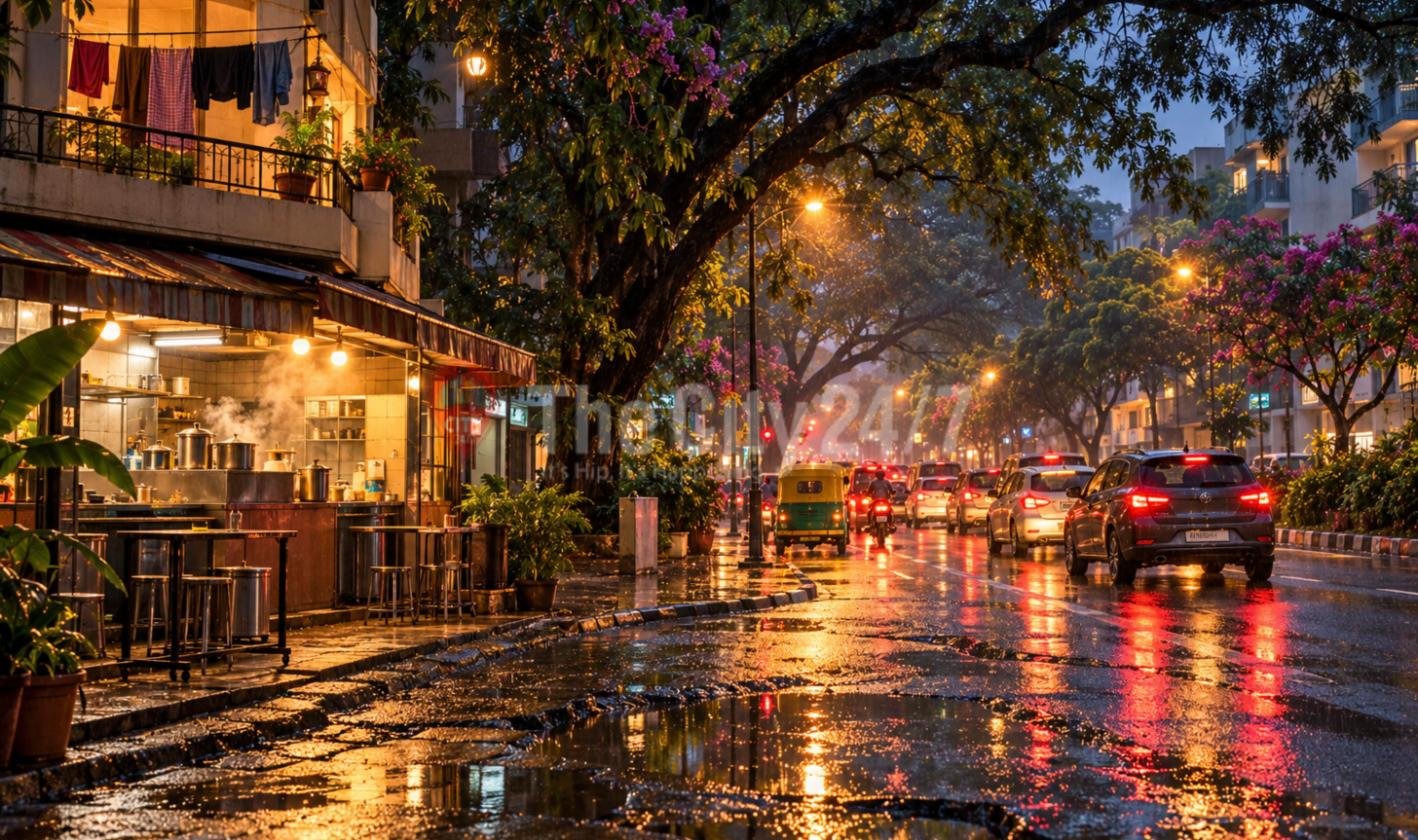
“Nobody moves to Bengaluru intending to stay. Everybody stays. Ask any of us how long we have been here and watch the surprise on our own faces.”
• The most common conversation in this city
Living in Bengaluru is a daily negotiation between two versions of the same city. There is the one at 6.30 in the morning, when the air is cool, the streets are quiet, the trees look like they belong to a hill station and you cannot believe your luck. And there is the one at 6.30 in the evening, when a four kilometre journey takes fifty minutes and you question every decision that led you here. Both are entirely real. Most residents have made peace with the pair of them, and the ones who have not tend to leave within a year.
This is the honest version, not the brochure. It covers the weather, the traffic, the money, the people, the food, the loneliness that nobody mentions, and the specific things that make this city genuinely difficult. It is written for anybody deciding whether to move here, and for anybody who has just arrived and is wondering whether the first month is representative. It is not, incidentally. Month one is the worst of it.
The short answer, before the long one: Bengaluru is the easiest major Indian city to build an adult life in, and the hardest one to travel across. Whether that trade works for you depends almost entirely on decisions you make in your first month, particularly where you live and how far it sits from where you work.
Quick Information
Everything a brochure would leave out, tabled honestly. Read the traffic row twice, because it decides more about your happiness here than your salary does.
Is the Weather in Bangalore Really That Good?
Yes, and it is not exaggerated. Bengaluru sits at roughly 900 metres, which gives it a climate no other major Indian city has: mild almost all year, rarely above the mid thirties, and cool enough in December and January that you will own a jacket you never expected to buy.
What people underestimate is how much this changes daily life. You can walk at 7 AM in June. You can eat outdoors in April. Air conditioning is optional in most of the city and most of the year, which is a meaningful saving and a meaningful comfort. The two caveats are real though: April and May get genuinely warm now in a way old residents will tell you they did not twenty years ago, and monsoon evenings can flood specific low-lying areas quickly and severely. Our Bangalore weather guide covers the year month by month.
If you take one piece of advice from this entire article: become a morning person here. Bengaluru between 6 and 8.30 AM is a different, quieter, cooler, kinder city, and it is the version worth building your routine around. Everything after 9 AM is a compromise with traffic.
How Bad Is Bangalore Traffic, Honestly?
Bad enough that it should determine where you live, and that is the honest framing. Peak-hour speeds across the city are low, the Outer Ring Road tech corridor is among the worst commutes in the country, and a distance that looks like fifteen minutes on a map can reliably take fifty.
The thing nobody explains is that traffic here is not evenly distributed misery. It is highly specific. Some corridors are consistently awful at predictable hours, and vast parts of the city are perfectly fine most of the time. Residents solve this not by leaving earlier but structurally: living near work, living on a metro line, working hours that dodge the peak, or simply refusing to cross the city on a weekday evening. That last one is a genuine social rule here, and nobody takes offence at it.
- The six kilometre rule. Live within about six kilometres of your workplace if you possibly can. It is worth paying more rent for. People who ignore this spend two to three hours a day in a car and are unhappy within six months.
- Or live on the metro. Namma Metro has changed the calculation considerably, and living near a station on your line is now a legitimate alternative to living near the office. Our metro guide has the routes and fares.
- The two wheeler reality. A scooter or bike is dramatically faster than a car in this city and most residents eventually get one. Helmet, insurance and defensive riding, non-negotiable.
- Autos and cabs. Autos are quick and often refuse app fares, cabs are cheap and often cancel. Both are normal. Keep both apps and expect to negotiate occasionally.
- Never cross the city at 6 PM. East to south, or north to Electronic City, on a weekday evening, is a genuinely poor use of your one life. Move the plan or move the day.
- Rain changes everything. Twenty minutes of heavy rain doubles every journey and floods known spots. If it is pouring at 5.30 PM, stay where you are and have a coffee. This is standard local practice.
How Much Does It Cost to Live in Bangalore?
Roughly 35000 to 70000 rupees a month for a single person living comfortably, with rent as the dominant variable. Bengaluru is not cheap by Indian standards but it is meaningfully cheaper than Mumbai and offers a great deal more space for the money.
- Rent. 1BHK 15000 to 30000, 2BHK 25000 to 60000, wildly dependent on area. Indiranagar and Koramangala command a premium, the outer areas and west are far better value.
- The deposit shock. Bengaluru landlords traditionally ask 6 to 10 months rent as deposit, which is the single biggest financial surprise for newcomers. It is negotiable, increasingly so, but budget for it.
- Food. Absurdly flexible. A hundred rupees a day is possible and pleasant. Three thousand a night is also possible. Most residents live comfortably between the two.
- Utilities. Electricity is modest without heavy AC use. Water may involve tanker costs in some areas. Internet is cheap and generally excellent.
- Transport. Metro and bus are inexpensive, cabs and autos add up quickly, a two wheeler is the cheapest real freedom in the city.
- Help. Domestic help, cooking and cleaning arrangements are common and affordable, and are a large part of why the quality of life here surprises people.
- The invisible cost. Delivery. Bengaluru's convenience economy is superb and quietly expensive. This is where most residents' money actually disappears.
Our cost of living in Bangalore guide breaks all of this down with realistic monthly budgets at different income levels.
Is It Easy to Make Friends in Bangalore?
Easier than in most Indian cities, because almost everybody here came from somewhere else and remembers what that felt like. Bengaluru is a migrant-majority city and it has a distinctly low-friction social culture as a result.
The mechanism, though, is interest-based rather than proximity-based. You will not become close to your neighbours the way you might in a smaller city. You will make real friends through a running group, a climbing gym, a book club, a jam night, a football pickup game, a startup community or a badminton court. The city has an enormous supply of all of these and they are genuinely welcoming to newcomers. What it demands is that you show up to something repeatedly for about six weeks.
The first two to three months here are frequently lonely, even for sociable people, and it has nothing to do with you. Traffic makes casual meeting hard, everybody's existing friends live forty minutes away, and work absorbs the rest. It passes, reliably, once you join something with a fixed weekly time. Join in week one, not month three.
Do I Need to Speak Kannada to Live in Bangalore?
No, and you should learn some anyway. English works everywhere in Bengaluru: offices, shops, hospitals, restaurants, autos, apps. You can live here for years without a word of Kannada and thousands do.
But this is Karnataka, Kannada is the state language, and the small effort is repaid disproportionately. Twenty words will change how autorickshaw drivers, shopkeepers, security staff and neighbours deal with you, immediately and warmly. Learn the greetings, the numbers, left and right, how much, and thank you. It takes an evening. It also matters as a matter of basic respect for the place you have chosen to live in, and long-term residents who never bothered generally regret it.
What Is the Food and Going Out Culture Like?
Excellent, cheap at the bottom, ambitious at the top, and it closes at 1 AM. Bengaluru is arguably India's best eating city because migration brought every regional cuisine here and none of it got diluted.
- Breakfast is the best meal. The darshini culture means a genuinely excellent South Indian breakfast costs under a hundred rupees. This is the single greatest daily pleasure of living here.
- Craft beer is the default. Roughly 60 to 70 microbreweries. Fresh house-brewed beer is normal rather than special, and priced fairly.
- Every cuisine, done properly. Andhra, Mangalorean, Kerala, Bengali, Tibetan, North East Indian, Japanese, Italian. Not tourist versions, real ones, because the diaspora that eats them lives here.
- Vegetarian paradise. Possibly the best city in the world to be vegetarian, and it is never treated as a restriction.
- The 1 AM wall. Bars stop serving around 1 AM, and standalone microbrewery pubs at 11.30 PM and the city empties fast. If you are coming from Delhi or Mumbai nightlife, this is the adjustment.
- Coffee is a religion. Filter coffee at one end, serious third wave roasters at the other, and both taken very seriously by people who will explain why at length.
Our ultimate Bangalore food guide is the full map of it, and it is the article I would read first if I were moving here.
What Are the Genuinely Hard Things About Living in Bangalore?
Traffic, water, infrastructure that lags the population, and the feeling that the city is being rebuilt around you at all times. These are not small complaints and pretending otherwise does newcomers no favours.
- Traffic and commute. The defining difficulty. It costs you hours, it constrains your social life, and no amount of planning fully solves it. Only location does.
- Water supply. Hard water citywide, and genuine supply issues in parts of the east and south-east where tanker dependence is normal. Ask about the water source before you sign a lease. Always.
- Monsoon flooding. Specific low-lying areas flood quickly and badly. This is very local knowledge, and it is worth asking neighbours rather than agents.
- Permanent construction. Metro works, road works, drain works. Something near you will be dug up for months. It is the price of infrastructure catching up, but it is loud and dusty while it happens.
- Air quality and dust. Better than north India, worse than it used to be here. Construction dust in particular is a real irritant in fast-growing areas.
- Rental deposits and agent culture. Large deposits, brokerage fees and a landlord market that has been in charge for a long time. Improving, but expect friction.
- The distance problem, socially. Friends who live forty minutes away become friends you see monthly. This is the quiet cost of the city's size and it catches everybody eventually.
So Who Is Bangalore Actually Right For?
It is right for people building a career and a life at the same time, and it is unusually good at both. It is a difficult fit for anyone who needs a short commute they are not willing to plan for, or who wants a city that stays open past 1 AM.
- Young professionals. The best city in India for this, comfortably. Work opportunity, social ease, food, weather and a large population of people in exactly your situation.
- Couples. Excellent. Things to do, easy weekends, safe to be out late, and enough space to build a routine that is yours.
- Families. Strong on schools, healthcare, parks and safety. The constraint is school commute, which quietly dictates where families end up living.
- Entrepreneurs. The obvious answer in India. Capital, talent, community and a culture that treats a failed startup as experience rather than embarrassment.
- Remote workers. Very good. Weather, cafes, coworking, cost and community. The commute problem simply does not apply to you, which removes the city's main flaw.
- Retirees. Historically a favourite for the climate, and still is in the older, quieter, greener areas of the south and west.
- Anyone who wants a compact city. This is the mismatch. Bengaluru is large, spread out and getting larger. If you want everything within a fifteen minute walk, choose your neighbourhood extremely carefully or choose another city.
If you are actually making the move, our moving to Bangalore guide is the practical checklist, and best areas to live in Bangalore is where the six kilometre rule becomes a real decision.
Living in Bangalore: Frequently Asked Questions
Is Bangalore a good city to live in?
Yes, particularly for working professionals, couples, remote workers and entrepreneurs. It has the best climate of any major Indian city, excellent food, strong job opportunity and an unusually easy social culture. Its main weakness is traffic, which is best solved by living close to work or on a metro line.
What is the biggest problem with living in Bangalore?
Traffic. Peak-hour speeds are very low and a short distance on a map can take fifty minutes. It shapes where residents live, when they socialise and how they plan their week. Water supply in parts of the east and south-east is the second real issue.
How much money do you need to live comfortably in Bangalore?
Roughly 35000 to 70000 rupees a month for a single person, with rent as the biggest variable. A 1BHK costs 15000 to 30000 and a 2BHK 25000 to 60000 depending heavily on the area.
Is Bangalore weather really as good as people say?
Yes. At around 900 metres of elevation, it stays roughly between 15 and 34 degrees through the year, rarely gets genuinely hot and needs no heating in winter. April and May are warm and the two monsoons bring heavy evening rain, but no other major Indian city comes close.
Do I need to know Kannada to live in Bangalore?
No. English works everywhere in the city, in offices, hospitals, shops and cabs. Learning twenty words of Kannada is still worth it, because it changes daily interactions immediately and it is a basic courtesy in Karnataka.
Is it easy to make friends in Bangalore?
Yes, though through shared interests rather than proximity. Almost everybody here is a migrant, which makes the social culture unusually open. Running groups, gyms, book clubs, sports and startup communities are the standard routes, and the first two to three months are commonly lonely before that clicks.
Is Bangalore safe?
It is regarded as one of the safer major Indian cities, including for women, with active nightlife areas and generally reliable late-evening cabs. Normal urban precautions apply, and traffic is a far bigger day-to-day risk than crime.
Where should a newcomer live in Bangalore?
Within about six kilometres of your workplace, or near a metro station on your line. Indiranagar, Koramangala, HSR Layout and Jayanagar suit central and southern workplaces, Whitefield and Sarjapur Road for the eastern tech belt, and north Bengaluru for Manyata and the airport corridor.
What should I check before renting in Bangalore?
The water source and supply reliability, whether the area floods in monsoon, the deposit amount, the commute at actual peak hour rather than on a map, and power backup. Water and monsoon flooding are very local and worth asking neighbours about, not agents.
How long do people usually stay in Bangalore?
Far longer than they intend to. The most common story in the city is someone who came for a two year job and is still here a decade later, which says more about the place than any single statistic.
Is Bangalore better than Mumbai, Delhi or Hyderabad to live in?
For climate and quality of life it beats all three. It is cheaper and roomier than Mumbai, milder and cleaner than Delhi, and richer in food, nightlife and job opportunity than Hyderabad. Hyderabad has better traffic and cheaper housing, which is the honest counterpoint.
What Did Nobody Tell You?
If you moved here and something caught you completely off guard, good or bad, I want to hear it. Click the WhatsApp icon at the bottom right of your screen and tell me what you wish you had known in month one. The best lines in this article came from readers doing exactly that. It is also the fastest way to reach The City 24/7 about anything at all.
And if you want the city explained one useful thing at a time, join our ever growing community. One weekly email, free, written by someone who still gets the traffic wrong occasionally.
Same city, new stories, always.

Related Stories
 LIFESTYLE
How to Spend a Weekend in Bangalore Without Leaving the City
September 8, 2026
 LIFESTYLE
Bangalore at Night: Live Music, Late Food and the 1 AM Problem
September 13, 2026
 LIFESTYLE
The Bangalore Bucket List: 50 Experiences Everyone Should Have
September 13, 2026
 LIFESTYLE
Bangalore for Introverts and Extroverts: Alone, or in a Crowd
September 13, 2026
 LIFESTYLE
Bangalore for Young Professionals: Your First Year, Done Properly
September 13, 2026
 LIFESTYLE
The Best Places in Bangalore With Friends, and How to Get Eight People There
September 9, 2026
