


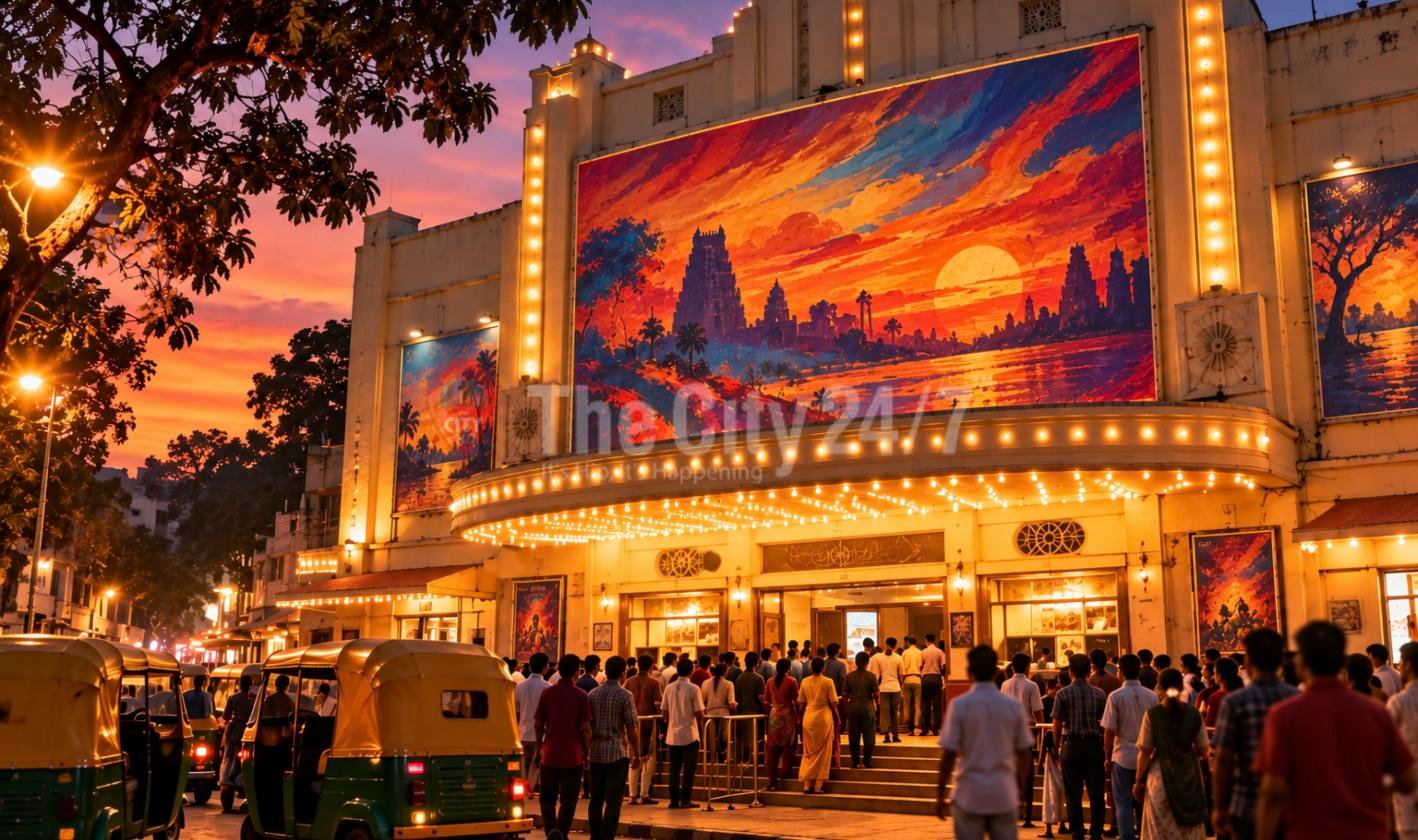
“For an entire generation of Kannadigas, he was not a film star. He was the elder brother who told you how to live.”
• On why he is called Annavru
Dr Rajkumar was the most celebrated actor in the history of Kannada cinema, with more than 200 films between 1954 and 2000. Born Singanalluru Puttaswamaiah Muthuraj in 1929, he was also a playback singer who won a National Film Award, a recipient of the Padma Bhushan and the Dadasaheb Phalke Award, and the leading face of the 1980s Gokak agitation for Kannada. He died in Bengaluru on April 12, 2006, and is buried at Kanteerava Studios.
You cannot live in Bengaluru for long without meeting him. His face is painted on auto rickshaws, framed in tea shops and printed on the calendars behind bakery counters. Say Annavru, elder brother, to almost any Kannadiga and they know exactly who you mean. I have seen grown men get emotional talking about a film they watched with their grandfather, and I have learned not to interrupt.
A full filmography would fill this page twice over. This is his Bangalore story instead: how a boy from a travelling theatre company became the conscience of a language, and why his memorial is still one of the most visited places in the city.
Quick Information
Two hundred films, one golden voice and a following no politician has matched. If an auto in Bengaluru has a portrait on it, the odds are good it is this man.
Who Was Dr Rajkumar?
He was the defining star of Kannada cinema for nearly half a century. He grew up in a family of stage performers, learned his craft touring with the Gubbi Veeranna company, and made his debut as a lead in Bedara Kannappa in 1954. Over the next four decades he played gods, kings, saints, farmers, detectives and ordinary men, and he did it with a restraint audiences trusted.
- Mythologicals. Films like Bhakta Kanakadasa and Babruvahana made him the face of Kannada devotional and epic cinema.
- Historicals. Mayura and Sri Krishnadevaraya put Karnataka's own history on screen.
- Social dramas. Bangaarada Manushya (1972) became a cultural event, and is still remembered for inspiring people to return to farming and village life.
- Spy films. Jedara Bale and Operation Diamond Racket gave him a Kannada James Bond run in the sixties and seventies.
- Late career. Jeevana Chaitra (1992) and Aakasmika (1993) showed him at his most assured.
Why Is Dr Rajkumar So Important to Bengaluru?
Because he gave Kannada, and Kannadigas, a figure of pride in a city that was changing faster than anyone could keep up with. Bengaluru has always been cosmopolitan, and through the second half of the twentieth century many Kannada speakers felt their language was being pushed to the margins of their own capital. Rajkumar stood for the language without ever seeming to stand against anyone.
His public image was unusually clean. He was known for avoiding alcohol and tobacco on screen, for refusing to play villains, and for a discipline with yoga and diet that he kept into old age. Fans took that seriously. He was a star people wanted their children to copy.
“He never went into politics, and that is exactly why he could move the whole state when he chose to.”
• On the Gokak agitation
What Was the Gokak Agitation?
It was a 1982 movement demanding that Kannada be given primacy in school education in Karnataka, following the recommendations of a committee headed by V K Gokak. Rajkumar joined and led it, touring the state and drawing enormous crowds, and the government accepted the key recommendations. It remains the single clearest example of his influence beyond cinema.
What Happened When Veerappan Kidnapped Rajkumar?
On July 30, 2000, the forest brigand Veerappan abducted Rajkumar from his farmhouse at Gajanur. He was held for 108 days in the forest and released on November 15, 2000, after prolonged negotiations. Bengaluru spent those three and a half months on edge, and the relief when he returned is still vividly remembered by anyone who lived here at the time.
Was Dr Rajkumar Also a Singer?
Yes, and a very good one. He began singing his own songs in films from the 1970s, and his voice became almost as famous as his face. He won the National Film Award for Best Male Playback Singer for Naadamaya Ee Lokavella from Jeevana Chaitra. His devotional albums are still played in homes and temples across Karnataka.
Rajkumar never finished formal schooling. He learned on stage from childhood, and by the end of his career he had honorary doctorates, national honours and a reputation for impeccable Kannada diction. The Dr in his name comes from an honorary doctorate awarded by the University of Mysore.
Which Dr Rajkumar Films Should a Newcomer Watch First?
Start with Bangaarada Manushya, then Mayura, then Jeevana Chaitra. Those three cover his range: the social drama that changed how Karnataka thought about village life, the historical epic about the founder of the Kadamba dynasty, and the late-career film that won him a national award for singing. Subtitled versions are available on several streaming platforms.
- Bangaarada Manushya (1972). A man returns to his village and transforms it through farming. It ran for well over a year in Bengaluru theatres.
- Mayura (1975). The story of Mayurasharma, founder of the Kadamba dynasty. Rousing, and a favourite at Rajyotsava screenings.
- Babruvahana (1977). A mythological with some of his most famous dialogue and songs.
- Kasturi Nivasa (1971). A tragedy about a generous industrialist, and one of the most loved Kannada films of its era.
- Jeevana Chaitra (1992). A late classic about a man fighting the liquor trade in his village, with the award-winning song Naadamaya.
Where Can You See Dr Rajkumar's Legacy in Bengaluru?
At Kanteerava Studios, where he is buried, and almost everywhere else in the city in smaller ways. The memorial draws visitors daily and huge crowds on his birth and death anniversaries. His wife Parvathamma and his son Puneeth are buried nearby.
- Dr Rajkumar Samadhi. Kanteerava Studios, off Tumkur Road in north west Bengaluru. Visitors bring flowers every day, and April 24 and April 12 draw large crowds.
- Dr Rajkumar Road. The main road through Rajajinagar carries his name.
- On autos and walls. Portraits of Annavru remain one of the most common sights on Bengaluru's roads.
- Kannada Rajyotsava. November 1, when his songs are played at celebrations across the city.
- His films. Many classics are available on streaming platforms, and Kannada channels still show them regularly.
Visit the memorial on an ordinary weekday morning. You will see families, elderly fans and young couples, and you will understand the relationship between this city and this man faster than any article can explain it.
What Can Bangaloreans Learn From Dr Rajkumar?
That influence built slowly, through consistency, lasts. He did not chase trends or controversies. He made films, sang, kept his public life simple, and used his standing sparingly and for causes he believed in. For newcomers, understanding Rajkumar is also one of the best ways to understand the Kannada side of this city.
Why Does Dr Rajkumar Belong in People of Bangalore?
Bengaluru was the centre of the Kannada film industry he defined, the city where he lived, worked and died, and the place where his memorial still draws visitors every day. For millions of Kannadigas, he is the emotional heart of their capital.
FAQs
Who was Dr Rajkumar?
Dr Rajkumar was the most celebrated actor in Kannada cinema, with more than 200 films from 1954 to 2000. He was also an acclaimed playback singer and received the Padma Bhushan, the Karnataka Ratna and the Dadasaheb Phalke Award.
Why is Dr Rajkumar called Annavru?
Annavru means elder brother in Kannada. It reflects the affection and respect fans felt for him, as a figure who represented Kannada pride and a clean, disciplined public life.
Where is Dr Rajkumar's memorial in Bengaluru?
Dr Rajkumar's memorial, or samadhi, is at Kanteerava Studios in north west Bengaluru, off Tumkur Road. His wife Parvathamma and son Puneeth Rajkumar are also buried there.
How many films did Dr Rajkumar act in?
He acted in more than 200 films, almost all in Kannada, starting with Bedara Kannappa in 1954 and ending with Shabdavedhi in 2000.
What was Dr Rajkumar's role in the Gokak agitation?
In 1982 he joined and led the Gokak agitation demanding primacy for Kannada in school education in Karnataka. His involvement drew huge crowds across the state and the government accepted the movement's key demands.
When did Veerappan kidnap Dr Rajkumar?
Veerappan kidnapped Dr Rajkumar from his Gajanur farmhouse on July 30, 2000. He was held for 108 days and released on November 15, 2000.
Did Dr Rajkumar win a National Award for singing?
Yes. He won the National Film Award for Best Male Playback Singer for the song Naadamaya Ee Lokavella from the 1992 film Jeevana Chaitra.
When did Dr Rajkumar die?
Dr Rajkumar died of a cardiac arrest in Bengaluru on April 12, 2006, aged 76. His funeral drew enormous crowds across the city.
Contact Details
Where to pay respects and where to learn more.
Grew Up on Annavru's Films?
If you have a favourite Rajkumar film you think every newcomer should watch first, or a family memory of the man himself, Click the WhatsApp icon at the bottom right of your screen and tell me. That is also the easiest way to reach The City 24/7 about anything at all, including nominating someone for People of Bangalore.
And if you want one story about the people who make this city, every Sunday, join our ever growing community at thecity247.kit.com/join-the-community. Free, and about ten seconds of your life.
Same city, new stories, always.

Related Stories
 CINEMA
Puneeth Rajkumar: Why Bengaluru Still Lines Up to Say Goodbye to Appu
September 23, 2026
 CINEMA
Rakshit Shetty: The Engineer Who Became the Kannada New Wave's Storyteller
September 23, 2026
 CINEMA
Duniya Suri: The Gottigere Signboard Painter Who Made Kannada Cinema Gritty
September 24, 2026
 CINEMA
Hemanth M Rao: The Bangalore Engineer Who Wrote Andhadhun and Made Sapta Saagara
September 24, 2026
 CINEMA
Anant Nag: Five Decades of Kannada Cinema, and a Detour Through Benegal
September 23, 2026
 CINEMA
Ganesh: Mungaru Male and the Golden Star
September 23, 2026
