


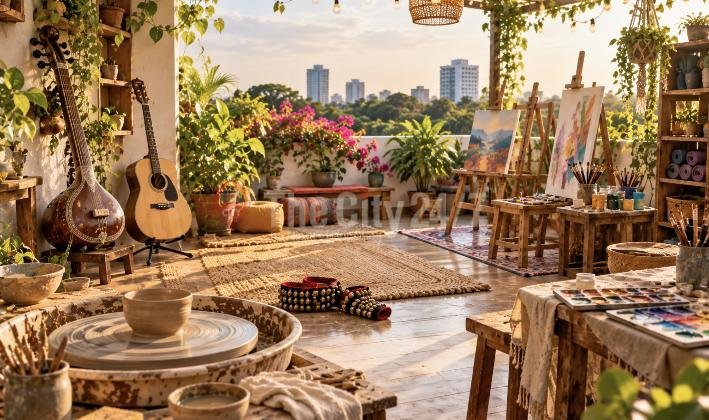
“A hobby class in this city is two things at once: the thing you signed up to learn, and eight weeks of the same people in a room. The second is frequently why people stay.”
• On the underrated function of a pottery course
Bengaluru has an unusually deep hobby class market, and it spans two quite different worlds. There is the classical tradition, Carnatic music, Hindustani vocal, Bharatanatyam, veena and tabla, taught in the old way by teachers with lineages, frequently in their own homes. And there is the contemporary market of pottery studios, guitar schools, baking classes, photography workshops and language courses.
Both are good and they operate completely differently on price, structure and expectation. A classical music teacher may take you on for years and charge a few thousand rupees a month. A weekend pottery workshop is a fixed six week commitment at a studio with a booking system.
This guide covers what each costs, where to find them, what to ask before enrolling, and how to pick something you will keep attending, which is the part everybody gets wrong. Our young professionals guide makes the case for why this matters socially as much as personally.
Quick Information
Monthly costs across the main options. Classical teaching is frequently the best value in the city.
What Classical Arts Can I Learn in Bangalore?
Carnatic and Hindustani vocal, veena, violin, flute, tabla and mridangam, Bharatanatyam and other classical dance forms. Roughly fifteen hundred to seven thousand rupees a month, frequently taught at the teacher's home.
This is one of the genuinely special things about living in this city and it is largely invisible to newcomers, because these teachers do not advertise. They take students by reference, teach in their own homes or small schools in the older neighbourhoods, and think in terms of years rather than courses. The fees are frequently remarkably low relative to what is being transmitted.
Jayanagar, Basavanagudi, Malleshwaram and Rajajinagar are where to look, and the route in is to ask, at a sabha concert, at a temple, or through neighbours. Adults are welcome, and starting at thirty five is entirely normal. Be honest with a teacher about how much practice time you have, because the classical tradition assumes daily practice and a teacher would rather know that upfront.
“The best classical teachers in this city do not advertise and are found by asking somebody who already learns. That is a feature of the tradition rather than a barrier.”
• On how to actually find a guru
What Contemporary Classes Are Worth Doing?
- Pottery, at Rs 6,000 to 15,000 for a course. The most popular hobby class in the city and genuinely absorbing. Six to eight weeks, small groups, and one of the better formats for meeting people. Check whether materials and firing are included.
- Kannada classes, at Rs 3,000 to 10,000. The highest return class available to anybody living here. Even basic Kannada changes how autorickshaw drivers, shopkeepers and neighbours respond to you, immediately and noticeably.
- Guitar, piano and western music, Rs 2,500 to 8,000 a month. Well supplied through schools and private teachers. For adults starting out, private lessons frequently work better than group classes.
- Improv and theatre, Rs 3,000 to 12,000 for a workshop series. Bengaluru has an active improv scene attached to its comedy circuit, and it is the single best format on this list for people who want to be less self conscious.
- Photography workshops. Rs 3,000 to 15,000, frequently including field trips to the markets, the old city or out of town, which doubles as a good way to see Bengaluru properly.
- Baking and cooking, Rs 1,500 to 6,000. Single sessions or short courses, including regional Indian cooking, which is worth doing if you want to understand the food covered in our local food guide.
- Dance, from classical to contemporary and salsa. Rs 2,000 to 5,000 a month. Social dance forms in particular have active communities here and a low barrier to joining.
How Do I Choose a Class I Will Actually Finish?
Pick something within twenty minutes of home, at a time you can reliably make, with a fixed weekly slot. Distance and scheduling are why people stop, not lack of interest.
- Distance over prestige. A class across the city is a class you will abandon in week four. In Bengaluru traffic, twenty minutes each way is the realistic upper limit for something you do after work.
- A fixed weekly slot, not flexible booking. Flexible sounds better and performs far worse. A fixed Tuesday evening becomes a habit; an open credit system becomes a refund request.
- Ask for a trial class. Most teachers and studios allow one. You are assessing the teaching, the group and whether you enjoy the room, none of which a website tells you.
- Check the group size. Six to twelve is ideal for most hobby formats. Large groups mean no individual attention; one to one is better for music and worse for meeting people.
- Confirm what is included. Materials, firing, instruments and equipment hire can add substantially, particularly for pottery, photography and painting. Ask for the all in number.
- Ask about the teacher's background. Training, performance or professional experience, and how long they have taught. In classical arts, ask about lineage, which teachers are usually pleased to discuss.
- Start with a short course. Six to eight weeks before committing to anything longer. Enthusiasm at enrolment is a poor predictor of attendance in week ten.
- Choose the social format if that matters. Pottery, improv, dance and language classes put you in a room with the same people repeatedly, which is what builds friendships.
What About Classes for Children?
Extremely well supplied, particularly in classical music and dance, art, swimming and chess. Expect roughly fifteen hundred to eight thousand rupees a month depending on discipline and school.
Bengaluru's children's activity market is dense and the classical arts remain a genuine strength, with established dance and music schools in Jayanagar, Basavanagudi and Malleshwaram teaching children in a tradition that many families have followed for generations. Art, chess, coding, robotics, swimming and the sports academies covered in our sports guide fill out the rest.
The practical advice for parents is the same as for adults with one addition: watch the child rather than the certificate structure. Many children's programmes here are built around graded examinations and performance milestones, which suits some children and turns others off an art form permanently. Ask what a normal class looks like, sit in on one if permitted, and be honest about whether your child is enjoying it. The point of a hobby is that it is a hobby.
Hobby Classes in Bangalore: Frequently Asked Questions
How much do hobby classes cost in Bangalore?
Roughly Rs 1,500 to 7,000 a month for classical music and dance, Rs 2,500 to 8,000 for guitar or piano, Rs 6,000 to 15,000 for a multi week pottery course, Rs 3,000 to 10,000 for a language course, and Rs 1,500 to 6,000 for baking and cooking sessions.
Where can I learn Carnatic music or Bharatanatyam in Bangalore?
In Jayanagar, Basavanagudi, Malleshwaram and Rajajinagar, largely through teachers who do not advertise and take students by reference. Ask at a sabha concert, at a temple or through neighbours. Adults are welcome and starting in your thirties is entirely normal.
What is the best hobby class for meeting people in Bangalore?
Pottery, improv, dance and language classes, because they put you in a room with the same people repeatedly over six to eight weeks. Repetition rather than one off events is what builds friendships, which matters if you are new to the city.
Should I learn Kannada in Bangalore?
Yes, and it is the highest return class available to anybody living here. Courses run roughly Rs 3,000 to 10,000, and even basic Kannada noticeably changes how autorickshaw drivers, shopkeepers and neighbours respond to you.
How do I choose a hobby class I will actually finish?
Pick something within twenty minutes of home, with a fixed weekly slot rather than flexible booking, after taking a trial class. Distance and scheduling are why people stop attending, not lack of interest.
What should I check before enrolling in a class?
The group size, ideally six to twelve for hobby formats, what is included in the fee since materials and firing can add substantially, the teacher's training and how long they have taught, and whether a trial class is available.
Where are hobby classes concentrated in Bangalore?
Classical music and dance are concentrated in Jayanagar, Basavanagudi, Malleshwaram and Rajajinagar, while contemporary formats such as pottery, improv, photography and western music cluster in Indiranagar, Koramangala, HSR Layout and Domlur.
Are there hobby classes for adults in Bangalore?
Yes, across everything from classical music to pottery, improv, languages and photography. Adult beginners are entirely normal, including in the classical arts, where teachers regularly take on students starting in their thirties and forties.
What classes are available for children in Bangalore?
Classical music and dance, art, chess, swimming, coding and robotics, plus the sports academies, at roughly Rs 1,500 to 8,000 a month. Many programmes are built around graded exams, so ask what a normal class looks like and watch whether your child is enjoying it.
Is a short course better than a long commitment?
To start with, yes. Six to eight weeks before committing to anything longer, since enthusiasm at enrolment is a poor predictor of attendance in week ten. Classical training is the exception, where teachers work in years rather than courses.
Teach Something, or Looking for a Class?
The best teachers in this city, particularly in the classical arts, are found entirely by reference and appear in no listing anywhere. If you teach something, or you are looking for a class and cannot find one near you, click the WhatsApp icon at the bottom right of your screen and tell me what and where. Connecting those two groups is one of the more useful things this site can do. That is also the fastest way to reach The City 24/7 about anything at all.
And if you want the city explained one useful thing at a time, join our ever growing community. One weekly email, free.
Same city, new stories, always.

Related Stories
 LIFESTYLE
Gyms, Yoga and Fitness Studios in Bangalore: What They Cost and How to Choose
August 8, 2026
 LIFESTYLE
Bangalore at Night: Live Music, Late Food and the 1 AM Problem
August 12, 2026
 LIFESTYLE
Indiranagar Club: The Bangalore Club Everyone's Talking About (For Good Reason)
October 30, 2026
 LIFESTYLE
Sri Rakum School For The Blind: Bangalore's Best-Kept Secret Superheroes
October 30, 2026
 LIFESTYLE
Gallery G, Lavelle Road: Bangalore's Most Serious Art Gallery
September 11, 2026
 LIFESTYLE
Bangalore for Introverts and Extroverts: Alone, or in a Crowd
August 11, 2026
