


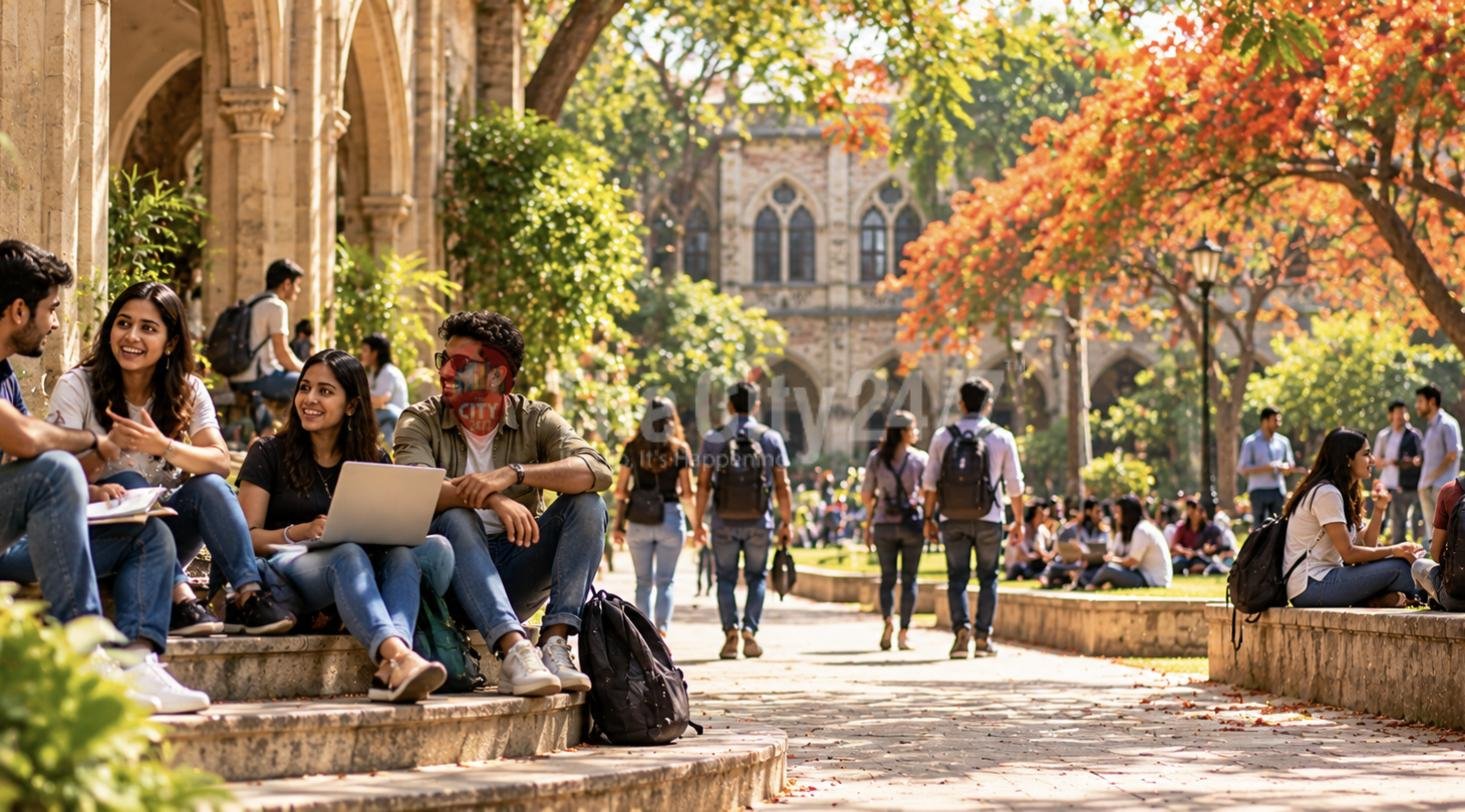
“This city's real infrastructure is not its roads. It is the number of people who graduated here and stayed.”
• On why Bengaluru works
Bangalore has one of the highest concentrations of higher education institutions in India, covering engineering, medicine, management, law, design, arts and sciences. That density is the foundation of the city's economy, and it is the reason employers here recruit locally at a scale seen almost nowhere else in the country.
For most students the decisive question is not which college is best in the abstract but which admission route applies to them: state quota through Karnataka CET, national exams, management or NRI quotas, or direct admission to private universities.
This guide covers the major institutions and course categories, the admission routes, fee expectations and how to choose sensibly between similar-looking options.
Quick Information
Higher education in this city, condensed for the student or parent currently drowning in college listing sites.
What Are the Main Universities and Institutions in Bangalore?
The Indian Institute of Science for research, Visvesvaraya Technological University for affiliated engineering colleges, and the three Bengaluru state universities for most undergraduate arts, commerce and science programmes.
- Indian Institute of Science. Established in 1909 and India's premier research institution in science and engineering. Primarily postgraduate and doctoral, with a small undergraduate programme.
- Visvesvaraya Technological University. The state technological university to which most engineering colleges in Karnataka are affiliated.
- Bangalore University, Bengaluru City University and Bengaluru North University. The state universities covering most undergraduate arts, science and commerce colleges across the city.
- Autonomous and deemed universities. A substantial private sector, including several long-established institutions with their own admission processes.
- National institutes. Bengaluru hosts national-level institutions across management, design, fashion technology and law.
How Do Engineering Admissions Work in Karnataka?
Through Karnataka CET for state quota seats, COMEDK for many private colleges, and JEE for national institutions. Most students in Bengaluru apply through more than one of these routes.
- Karnataka CET. Conducted by the Karnataka Examinations Authority, and the main route to government quota seats in state colleges. Requires Karnataka eligibility criteria to be met.
- COMEDK UGET. The entrance test used by a consortium of private engineering colleges in the state.
- JEE Main and Advanced. For national institutions, including the IITs and NITs.
- Management and NRI quotas. Available at many private institutions at significantly higher fees.
- Counselling. CET and NEET state quota counselling are conducted online by the Karnataka Examinations Authority. Documentation requirements are strict; prepare them early.
Karnataka eligibility for CET state quota depends on study and residence criteria, and the documentation is checked carefully at counselling. Families consistently lose seats over paperwork rather than ranks.
What About Medicine, Management, Law and Design?
NEET for medicine, CAT and its equivalents for management, CLAT and state tests for law, and NID or NIFT for design. Each has its own timeline, and all of them run on schedules that reward starting a year early.
- Medicine. NEET UG is the single entrance route, with state quota counselling by the Karnataka Examinations Authority and all-India quota counselling conducted centrally.
- Management. CAT for the top institutions, along with MAT, KMAT and institution-specific processes. Bengaluru hosts several strong business schools.
- Law. CLAT for national law universities, with additional state and institutional entrance routes for other colleges.
- Design. NID and NIFT entrance examinations, plus private institution tests. Bengaluru has a strong design education presence.
- Arts, science and commerce. Admission through the state universities and their affiliated colleges, generally on merit with institution-level processes.
What Does Higher Education Cost in Bangalore?
Government quota seats remain relatively affordable, while private university and management quota fees run to several lakh a year. The gap between these routes is the single biggest financial factor in the decision.
- Government quota engineering. Substantially subsidised, and the reason CET performance matters so much.
- Private college, CET or COMEDK seat. Mid-range, varying widely by institution.
- Management and NRI quota. Several lakh per year, and at the top end considerably more.
- Private universities. Fees vary enormously. Ask for a four-year total including all charges rather than a first-year figure.
- Hostel and living costs. Budget separately. Bengaluru's living costs are higher than most Indian college cities.
How Should I Choose Between Similar Colleges?
Compare placements honestly, then faculty, then location. College marketing is dominated by placement statistics, and those statistics are worth reading carefully rather than at face value.
- Read placement data properly. Ask for median rather than highest package, the percentage of the batch placed, and which companies recruited in the last two years.
- Ask about the department. In engineering, the branch and its faculty matter more than the college's overall reputation.
- Talk to recent graduates. Two years out, not final years. They will tell you what the degree was actually worth.
- Consider location. A college on the far side of Bengaluru means a commute or a hostel. Both are real costs.
- Check accreditation. NAAC and NBA accreditation status is public and worth confirming.
- Ignore the campus tour. Buildings are the least informative part of a college.
Why Do so Many Students Stay in Bangalore After Graduating?
Because the employers are here. The city's technology, research and services sectors recruit locally at a scale unmatched elsewhere in India, and a large share of graduates from Bengaluru institutions begin work in the same city.
That creates a loop that has run for four decades: institutions train engineers, employers hire them, those employers attract more institutions and more students, and the talent pool deepens. It is the same dynamic that made the city India's startup capital, viewed from the education side.
Best Colleges in Bangalore: Frequently Asked Questions
What are the top institutions in Bangalore?
The Indian Institute of Science for research, Visvesvaraya Technological University for affiliated engineering colleges, and the three Bengaluru state universities for most undergraduate programmes, alongside a substantial private and autonomous sector.
How do I get an engineering seat in Bangalore?
Through Karnataka CET for state quota seats, COMEDK for many private colleges, or JEE for national institutions. Management and NRI quotas are available at higher fees.
What is Karnataka CET?
The Common Entrance Test conducted by the Karnataka Examinations Authority, used for state quota admissions to engineering and other professional courses in the state.
How do medical admissions work in Karnataka?
Through NEET UG, with state quota counselling conducted online by the Karnataka Examinations Authority and all-India quota counselling handled centrally.
What does engineering cost in Bangalore?
Government quota seats are substantially subsidised. Private college and management quota fees run to several lakh a year, so ask for total four-year costs rather than first-year figures.
Which entrance exam do I need for management courses?
CAT for the top business schools, along with MAT, KMAT and institution-specific processes.
How should I compare colleges?
Look at median placement packages rather than highest, the percentage of the batch placed, department faculty, accreditation status and location. Talk to graduates two years out.
When does the academic year start?
Usually between July and September, following the completion of counselling.
Is it worth studying in Bangalore?
For most technology, science and management fields, yes. Local recruitment density means a large share of graduates find work in the same city.
What documents do I need for CET counselling?
Karnataka eligibility documentation covering study and residence criteria, along with academic records. Requirements are checked strictly, so prepare them well in advance.
Contact Details and Useful Links
The official portals for admissions and counselling.
Applying This Year?
Tell me the course and the route you are taking, and I will tell you what usually goes wrong with it. Click the WhatsApp icon at the bottom right of your screen. That is also the easiest way to reach The City 24/7 about anything at all.
And if you want Bengaluru's school, college and learning updates landing in your inbox each week, join our ever growing community. Free, ten seconds, and a lot more reliable than the algorithm.
Same city, new stories, always.

Related Stories
 EDUCATION
The Best CBSE Schools in Bangalore: The List, the Fees and the Honest Caveats
September 1, 2026
 EDUCATION
The Top Medical Colleges in Bangalore: MBBS Seats, Fees and How Counselling Actually Works
August 30, 2026
 EDUCATION
The Best Arts, Commerce and Science Colleges in Bangalore: Where a BA, BCom or BSc Still Means Something
September 2, 2026
 EDUCATION
The Top Boys' Schools in Bangalore: Bishop Cotton, Baldwin and What They Actually Cost
August 31, 2026
 EDUCATION
The Top Christian and Convent Schools in Bangalore: Why They Still Dominate the City's Education
August 31, 2026
 EDUCATION
The Top Girls' Schools in Bangalore: The List, and What Happens After Class 10
August 31, 2026
